
Abstract:
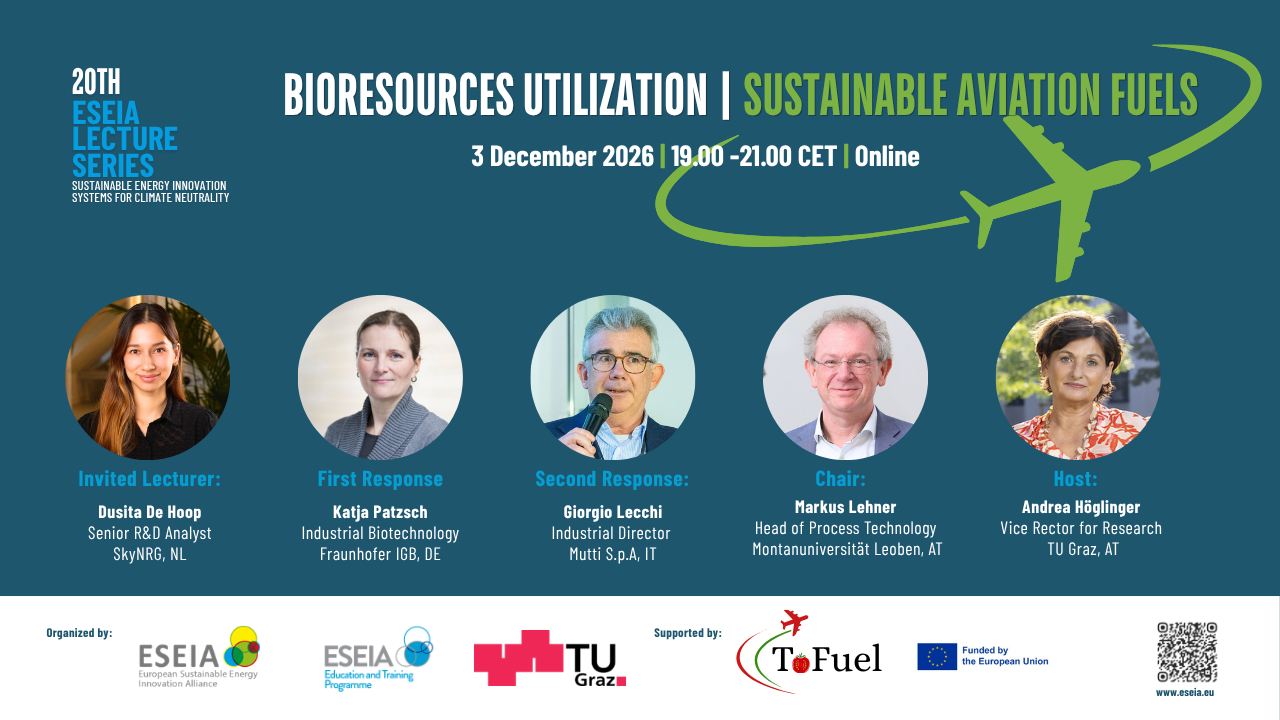
Aviation is responsible for over 2% of global CO₂ emissions, and decarbonising it is challenging. Sustainable Aviation Fuels (SAF) offer the most promising near‑term solution – but can bioresources deliver at scale without competing with food and feed production or natural ecosystems? This lecture examines feedstock availability, key conversion technologies, lifecycle emissions, and the economic realities of scaling up. We also explore the policy frameworks and innovation ecosystems needed to move SAF from pilot projects to commercial reality. The EU ToFuel project, which converts tomato waste into SAF, serves as a concrete example of regional circular bioresource utilisation.
Invited Lecturer:
Dusita De Hoop, Senior R&D Analyst, SkyNRG, NL
 Dusita De Hoop is Senior R&D Analyst at SkyNRG. She has a background in chemical engineering from Delft University of Technology and work experience in the petrochemical industry on topics of decarbonization. After finishing her Engineering Doctorate in process and equipment design, Dusita De Hoop joined SkyNRG in 2023. Her role focuses on the development of sustainable aviation fuel (SAF) through research on prospective feedstocks and novel SAF production technologies with key areas of interest in pathways using biomass. She is involved in multiple R&D projects on novel SAF production pathways and SAF certification.
First Response:
Katja Patzsch, Head of the Innovation Field Industrial Biotechnology, Fraunhofer IGB, DE
 Katja Patzsch is the acting head of the Innovation Field Industrial Biotechnology since 2020 and is the group leader of the Bioprocess scale-up since 2012 at Fraunhofer IGB (Institute for Interfacial Engineering and Biotechnology). She studied Biochemical Engineering at the Martin Luther University Halle-Wittenberg and has a PhD in engineering. In 2009 she joined Fraunhofer IGB and supported both the construction of Fraunhofer CBP (Center for Chemical-Biotechnological Processes) and the engineering and building processes of the biotechnological equipment.
Second Response:
Giorgio Lecchi, Industrial Director, Mutti S.p.A, IT
 Giorgio Lecchi is Industrial Director of Mutti S.p.A. with extensive experience in the food processing sector. He has held senior leadership positions at Mutti, where he served as Director of Operations and R&D Manager, overseeing manufacturing operations, innovation, efficiency, and sustainability initiatives. His expertise spans industrial operations, value-chain optimisation, food technology, and the implementation of smart manufacturing practices in the agri-food industry.
Chair:
Markus Lehner, Head of Chair, Process Technology & Industrial Environmental Protection, Montanuniversität Leoben, AT
 Markus Lehner is professor and head of the chair of process technology and environmental protection at Montanuniversity Leoben since 2010. Markus Lehner studied mechanical engineering with specialisation in chemical process engineering at TU Munich, where he also did his doctoral graduation. Since then, he held various positions in the industry, such as sales manager, engineering, and construction. His research interests and fields of activities are energy process engineering, thermal cracking, catalytic processes for CO2-utilisation, Power-to-Gas, and gas cleaning.
Host:
Andrea Höglinger, Vice Rector for Research, TU Graz, AT
An drea Höglinger has been Vice Rector for Research at TU Graz since October 2023. She was head of European and International Programmes (EIP) at the Austrian Research Promotion Agency (FFG) since 2011 and acted as the coordinating national contact point for Horizon Europe and is active in numerous EU programmes and initiatives. Andrea Höglinger graduated in social and economic sciences from the University of Vienna. She is also a member of WISIA “Women in Science”.
Concept:
Brigitte Hasewend, ESEIA Director
 Brigitte Hasewend is founding and acting Director and Member of the Governing Council of the European Sustainable Energy Innovation Alliance – ESEIA. In this executive capacity Brigitte has been responsible for devising the ESEIA Strategy 2034 in the context of the European Green Deal. In fall 2022, she started a new ESEIA-TU Graz lecture series entitled Climate Survival Campus for public debate on climate-friendly solutions.
In November 2023 she joined the EIT Climate-KIC Association Governing Board as a Member. In 2025–26 Brigitte Hasewend led the SET-Plan Task Force Access to the Market which came up with a set of five recommendations how to overcome market barriers for clean technologies.
ESEIA LECTURE SERIES 2027
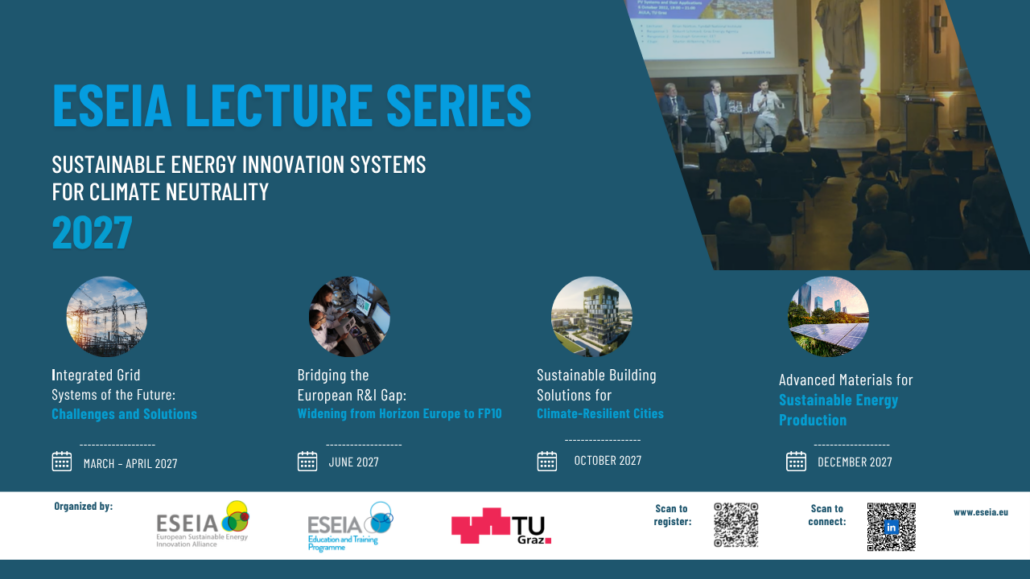
21st Lecture event: Integrated Grid Systems of the Future: Challenges and Solutions
March – April 2027 | 13.00-15.00 CET | online
Joint Lecture Series Event by ESEIA, EUREC, and ETIP PV
Exploring how integrated, flexible and resilient grid systems can accelerate Europe’s energy transition. The lecture connects renewables, energy storage, digitalisation and demand-side solutions with emerging European research, policy and market developments.
Registration coming soon.
22nd Lecture event: Bridging the European R&I Gap: Widening from Horizon Europe to FP10
16 June 2027 | 19.00-21.00 CET | online
Exploring how Europe can bridge research and innovation gaps as it transitions from Horizon Europe to FP10. The lecture examines the evolving Widening landscape and what the proposed reforms could mean for research institutions and collaborative R&I networks across Europe.
Registration coming soon.
23rd Lecture event: Sustainable Building Solutions for Climate-Resilient Cities
7 October 2027 | 19.00-21.00 CET | online (tbc)
Joint Lecture Series Event by ESEIA and AEE Intec
24th Lecture event: Advanced Materials for Sustainable Energy Production
2 December 2027 | 19.00-21.00 CET | online (tbc)
Joint Lecture Series Event by ESEIA and IAM-I