
18th ESEIA Lecture Series Explores Adaptive Reuse of Buildings and Urban Spaces During New European Bauhaus Festival 2026
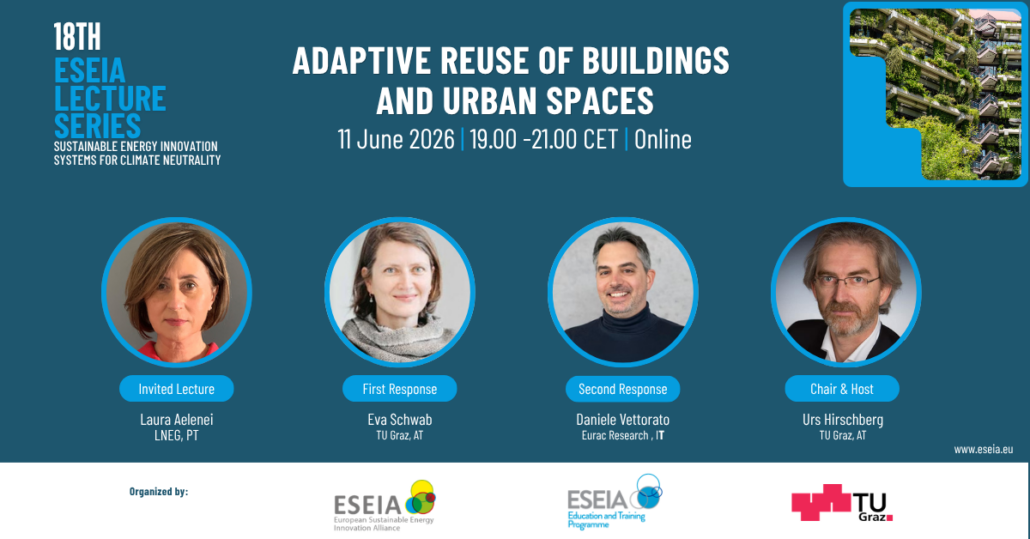
As Europe celebrates New European Bauhaus (NEB) Festival 2026, bringing together citizens, researchers, architects, policymakers, and innovators to shape more sustainable, inclusive, and beautiful living environments, the ESEIA Lecture Series dedicated its 18th edition to one of the most relevant topics for the future of European cities: Adaptive Reuse of Buildings and Urban Spaces.
Held online on 11 June 2026, the 18th ESEIA Lecture Series brought together 25 participants from 9 countries to explore how existing buildings and underused urban spaces can be transformed to support climate neutrality, social inclusion, and sustainable urban development. The topic aligns closely with the core values of the New European Bauhaus, which promotes sustainability, inclusiveness, and beauty as essential dimensions of Europe’s green transition.
The New European Bauhaus places communities at the centre of how we design buildings and common spaces, demonstrating how an inclusive, sustainable, and high-quality built environment can foster community, strengthen resilience, and boost competitiveness. Adaptive reuse is one of the most direct expressions of these values: rather than demolishing and rebuilding, it unlocks new ecological, social, and architectural value from existing structures and underused urban spaces, while significantly reducing demolition waste and embodied carbon.
Framed explicitly through the NEB values — sustainability, inclusiveness, and beauty — the evening reflected on both the strategic frameworks and the hands-on realities of adaptive reuse across European cities.
The lecture was opened by Brigitte Hasewend, ESEIA Director, who welcomed participants and highlighted the importance of adaptive reuse in creating sustainable, inclusive, and climate-neutral communities in line with the New European Bauhaus values.
Invited Lecture: Laura Aelenei, LNEG, Portugal
The evening’s invited lecture was delivered by Laura Aelenei, Senior Researcher and Scientific Coordinator for the Research Area Energy in Built Environment at LNEG (Laboratório Nacional de Energia e Geologia), Portugal. Holding a Master’s degree and PhD in Civil Engineering with a focus on Buildings Physics, Laura has co-authored more than 50 publications and led over 30 national and European R&D project proposals since 2009. Her research spans building energy efficiency, renewable energy systems integrated in building façades, Net Zero Energy Buildings and Communities, and interactive buildings in the context of Smart Cities — offering a compelling evidence base for the central theme of the evening.
Laura presented adaptive reuse as a strategic response to Europe’s climate and urban development challenges. Drawing on examples from Lisbon, Cascais, and several European research projects, she demonstrated how existing buildings and urban areas can be transformed through refurbishment, re-valorisation, citizen-centred regeneration, renewable energy communities, and digital urban modelling. Her presentation highlighted how adaptive reuse contributes to reducing embodied carbon, extending the life of existing assets, and supporting climate-neutral urban development.
Wach on YouTube: 18th ESEIA Lecture Series | Invited Lecture: Laura Aelenei, LNEG, Portugal
First Response: Eva Schwab, TU Graz, Austria
Eva Schwab, Assistant Professor and Deputy Head of the Institute of Urbanism at TU Graz, offered the first response. A landscape architect by training, Eva holds a PhD from the University of Natural Resources and Life Sciences Vienna, recognised with the Landscape Research Dissertation Prize 2026 and the City of Vienna Talent Award. She is the author of Spatial Justice and Informal Settlements (2018) and co-editor of Territorial Justice (2019), and her research focuses on the politics of public space, urban agriculture, migration, and rural development — bringing a critical social lens to questions of urban transformation.
Eva brought a social and spatial justice perspective to the discussion through inspiring European examples of adaptive urban transformation. She showcased projects such as De Ceuvel in Amsterdam, where a former contaminated harbour area was temporarily activated through floating structures and community-led uses, as well as public-space regeneration projects from Belgium, Austria, the Netherlands, Germany, Italy, and Slovenia. Her contribution highlighted how adaptive reuse can create more inclusive, people-centred, and resilient urban environments while reclaiming underused spaces for communities.
Wach on YouTube: 18th ESEIA Lecture Series | First Response: Eva Schwab, TU Graz, Austria
Second Response: Daniele Vettorato, Eurac Research, Italy
Daniele Vettorato, who leads the Urban and Regional Energy Systems research group at Eurac Research in Bolzano, Italy, provided the second response. With a PhD in Environmental Engineering from the University of Trento, over 65 publications, more than 1,000 citations, and experience across more than 100 lectures and events globally, Daniele brought an urban energy systems perspective to the discussion. He currently serves the International Energy Agency as an expert on Positive Energy Districts and was Sub-Task Leader on Solar Neighbourhood Planning. He is also one of the founders of the Institute for Urban Excellence.
Daniele expanded the conversation to the urban and regional scale, highlighting the enormous untapped potential of urban surfaces. He emphasized that while roofs account for approximately 20–25% of urban surfaces, building façades nearly double this available area, opening new opportunities for energy generation, climate adaptation, circular resource use, and urban regeneration. His intervention reinforced the importance of integrating adaptive reuse with urban energy systems and climate-neutral planning.
Wach on YouTube: 18th ESEIA Lecture Series | Second Response: Daniele Vettorato, Eurac Research, Italy
Chair and Host: Urs Hirschberg, TU Graz, Austria
The session was chaired and hosted by Urs Hirschberg, Professor for the Representation of Architecture and New Media at TU Graz, founding director of the Institute of Architecture and Media, and Dean of the Architecture Faculty. Urs holds an architecture diploma and doctorate from ETH Zurich and previously held positions at ETH Zurich and Harvard Graduate School of Design. As founding editor of GAM (Graz Architecture Magazine) and council member of EAAE, he brought both institutional depth and an architectural innovation lens to the evening’s moderation.
As Chair and Host, Urs guided the discussion through the lenses of architecture, innovation, and the New European Bauhaus values of sustainability, inclusiveness, and beauty, encouraging an interdisciplinary dialogue between architecture, urban planning, energy systems, research, and policymaking.
The 18th ESEIA Lecture demonstrated that adaptive reuse is no longer simply an architectural choice—it is a climate, resource, and societal necessity. It also reaffirmed the importance of collaboration across disciplines to unlock the potential of Europe’s existing built environment.
About the ESEIA Lecture Series
The ESEIA Lecture Series Sustainable Energy Innovation Systems for Climate Neutrality is organised in cooperation with Graz University of Technology – TU Graz, AT. It provides a platform for exchange between researchers, practitioners, industry, and policymakers on what must be done to achieve climate neutrality by 2050. TU Graz students can receive ECTS credits for participation.
Missed this session? Watch the recording on the ESEIA YouTube channel.
📅 The upcoming 19th ESEIA Lecture Series will focus on Energy System Modelling for Green Africa and will take place on 8 October 2026 | 19:00–21:00 CET | Online. Registration is now open.
🔗 Learn more: https://eseia.eu/education-and-training-running-courses/
📝 Registration is now open:
https://www.cognitoforms.com/Eseia1/ESEIALectureSeries19thLecture
Follow updates at eseia.eu and on ESEIA’s social media channels.

