
ESEIA Sustainable Campus Series | TU Wien, AT
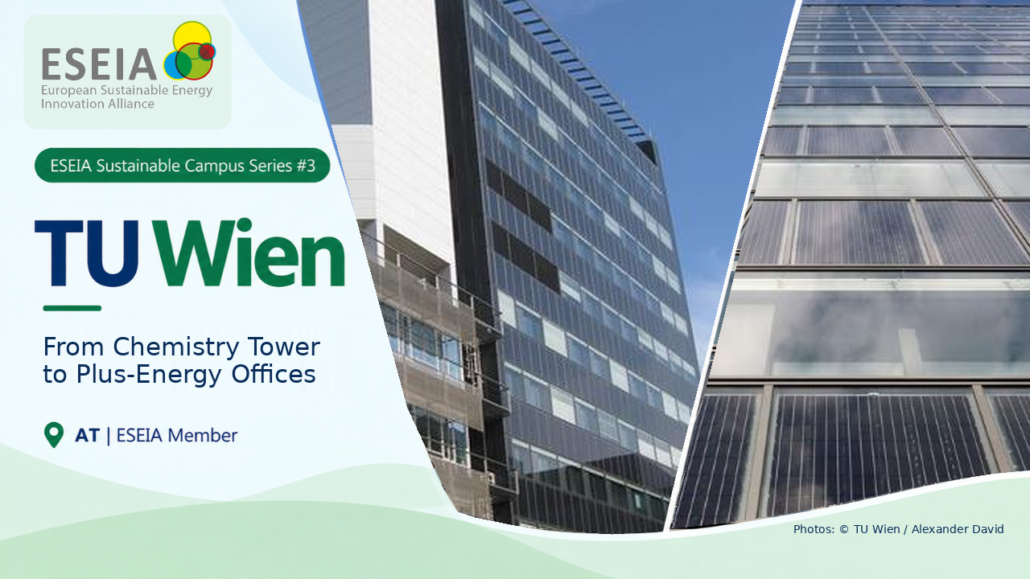
Can a university retrofit an existing tower so that it produces more energy over a year than it needs for standard office use? At its Getreidemarkt campus in Vienna, ESEIA member TU Wien tested that idea by turning a former chemistry tower into a Plus-Energy Office High-Rise.
Following TU Graz and the University of Twente, this edition of the ESEIA Sustainable Campus Series looks at what the retrofit can teach universities about adapting existing buildings, reducing energy demand and designing for how people will use the space.
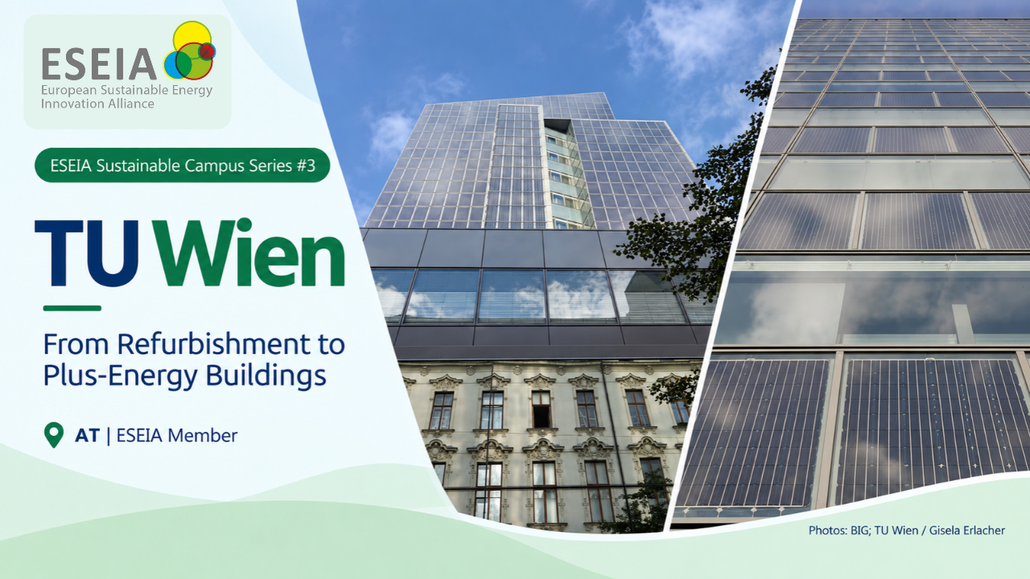
TU Wien’s project chronology dates the original tower’s construction to 1969–1971. The retrofit retained the reinforced-concrete frame while replacing the façade and building services. The chemistry laboratories relocated, and the tower was converted into offices for the Faculty of Mechanical and Industrial Engineering. The renovated building opened in November 2014.
The change in use shaped the energy strategy. Architects, engineers and researchers planned the envelope, building services and office equipment together, using a passive-house approach to reduce demand. The EXCESS case study records work on around 9,300 components across 280 categories, from lighting and ventilation to computers and servers.
With limited roof space, the team used both the façade and the roof for solar generation, installing approximately 2,199 m² of photovoltaics. TU Wien’s project brochure describes it as Austria’s largest plus-energy office building and highlights the scale of its façade-integrated solar system. The lifts recover electricity during braking, waste heat from servers helps heat the building, and automatic night ventilation helps manage summer temperatures.
TU Wien presented the project as the world’s first plus-energy office tower of its kind. Its published design calculations estimate 61 kWh/m² per year of on-site production against 56 kWh/m² per year of demand under standard office-use conditions. That scenario includes both building operation and everyday office equipment. In the university-use scenario, which also includes high-performance research computing, estimated demand rises to 108 kWh/m² per year. All three figures use the project’s non-renewable primary-energy accounting basis.
The building remains connected to the grid. Neighbouring campus buildings can use surplus solar electricity, and the tower can draw power from the grid when on-site production falls short. Monitoring after opening allowed researchers to compare planned and actual performance and investigate how equipment and occupant use affected energy demand.
The project earned klimaaktiv Gold and ranked first in the Austrian Sustainable Building Council’s Total Quality Building assessment, with 986 out of 1,000 points. TU Wien reports that findings from the project informed standards for subsequent campus projects and construction. For universities planning similar renovations, the case shows the value of agreeing early on what the energy target covers and checking performance once the building is in use.
Through the Sustainable Campus Series, ESEIA shares how its members put the sustainable energy transition into practice on their campuses.
Further reading
Previously in the ESEIA Sustainable Campus Series
