

ESEIA Sustainable Campus Series | TU Graz: An Integrated Roadmap to Climate Neutrality by 2030
ESEIA Sustainable Campus Series will explore across the Alliance how ESEIA members are turning their campuses into real-world environments for the sustainable energy transition.
How can a university campus move from individual sustainability measures to a truly integrated transition? In the first article of the ESEIA Sustainable Campus Series, we look at TU Graz, AT and its roadmap to climate neutrality by 2030.
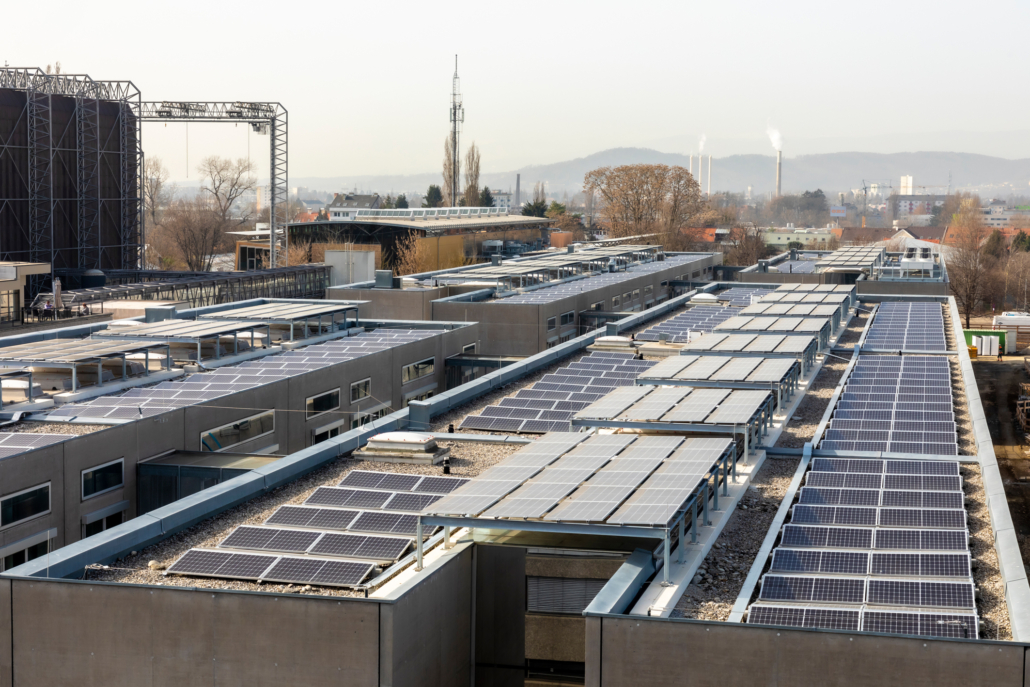
Photovoltaic systems at TU Graz. © Lunghammer – TU Graz
A climate-neutral campus cannot be built through one technology, one efficient building or one renewable energy project alone. It requires action across the entire institution, from energy and infrastructure to mobility, business travel, procurement, food, IT and everyday behaviour.
This integrated perspective is at the heart of Climate-Neutral TU Graz 2030 with implementation overseen by Michael Monsberger, Vice-Rector for Sustainability at TU Graz.
Starting from a comprehensive greenhouse gas inventory for 2017, TU Graz developed a roadmap comprising around 60 measures across six areas: mobility management, energy, business travel, buildings, materials/IT/cafeteria and compensation.
Energy and campus infrastructure
Energy is one of the central pillars of the roadmap. TU Graz combines energy efficiency with the production and procurement of renewable energy. Roof areas at Campus Inffeldgasse are being equipped with photovoltaic systems, while the university has moved towards electricity from certified renewable and regional sources.
The approach also includes heat pumps and geothermal storage in new buildings and greater use of waste heat, including heat generated by large computing systems. Campus Inffeldgasse is being developed as the Innovation District Inffeld, a living lab for future energy systems where university infrastructure can also become an environment for testing and demonstrating new solutions.
Buildings as part of the transition
Buildings are addressed not only through energy performance, but through a wider life-cycle perspective.
Together with Bundesimmobiliengesellschaft BIG, TU Graz is focusing on climate-optimised university buildings, integrating sustainability and climate neutrality from the beginning of new construction projects. The roadmap also covers the renovation of existing buildings and greening measures across campus locations.
This approach reflects an important principle of the sustainable campus transition: the building itself matters, but so do the way it is operated, the energy it uses and the resources embedded throughout its life cycle.
Mobility and business travel
The transition extends beyond the physical campus.
TU Graz promotes cycling and public transport as part of its mobility management strategy, together with e-mobility infrastructure and measures intended to reduce dependence on fossil-fuelled transport. The university reports that 40% of its employees commute by bicycle, while public transport use is supported through mobility subsidies.
Business travel is treated as a separate climate challenge. Under the principle “Stay grounded, keep connected,” TU Graz promotes rail and overnight-train travel as alternatives to short- and medium-haul flights, supports digital meetings where appropriate and has introduced a climate protection charge on flights. Its roadmap aims to reduce CO₂ emissions from employee air travel by 50% by 2030.
From IT and food to resource use
The roadmap also reaches into areas that can easily be overlooked when discussing campus decarbonisation.
TU Graz plans for its canteens to increasingly offer low-GHG food, applies a “digital by default” approach to reduce paper consumption and aims to extend the useful life of IT equipment to at least six years. For emissions that cannot be avoided, the roadmap also includes compensation mechanisms.
The result is a model in which climate neutrality is approached as an institution-wide transformation, rather than as a collection of isolated environmental projects.
A campus for implementation and experimentation
The transition is also connected to TU Graz research and innovation.
Recent examples highlighted by the university include a tool that identifies raw materials incorporated into buildings to support reuse and recycling, reusable brick-wall systems, a folding and sun-tracking photovoltaic system and an energy-efficient ceramic cooling wall, with a prototype already displayed on the TU Graz campus.
These initiatives are research and demonstration activities rather than individual measures of the climate-neutrality roadmap, but together they illustrate another dimension of the sustainable campus: a place where institutional transformation, research and real-world experimentation can reinforce each other.
TU Graz continues to document progress through internal progress reports, external evaluations and its Sustainability Report. The latest external evaluation listed on the Climate-Neutral TU Graz platform was carried out by the Austrian Environment Agency in January 2025.
As universities across Europe work towards their own climate targets, the TU Graz example shows that the transition is not only about making buildings more efficient or adding renewable energy. It is about connecting energy, infrastructure, mobility, resources, behaviour and research within one institutional strategy.
Sources | Official TU Graz sources used for this article: https://www.tugraz.at/en/tu-graz/university/climate-neutral-tu-graz/roadmap/ | News: Climate-neutral TU Graz

