
University of Twente Leads €8 Million National Research into Sodium-Ion Batteries
ESEIA member University of Twente is coordinating a major national consortium to develop next-generation battery technology reducing dependence on critical raw materials and advancing large-scale clean energy storage.
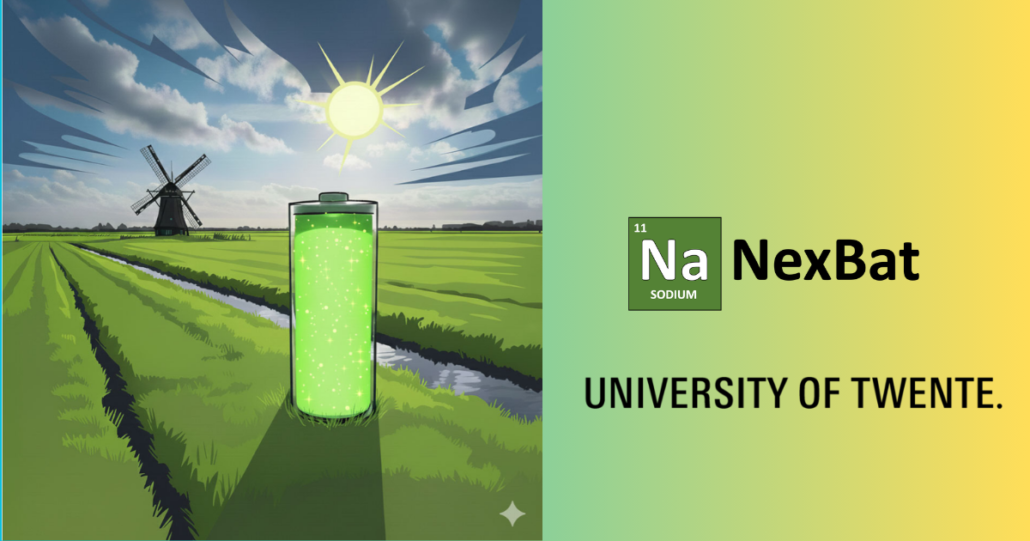
ESEIA member University of Twente (UT), NL, has been awarded €8 million by the Dutch Research Council (NWO) to lead NANEXBAT, a five-year national research consortium focused on developing next-generation sodium-ion batteries. The grant is part of the Netherlands’ national Growthfund programme Material Independence and Circular Batteries, which aims to accelerate the transition to more sustainable, resource-independent battery technologies.
Lithium-ion batteries have powered the first wave of the clean energy transition but they come with significant limitations. Lithium and other critical raw materials create geopolitical dependencies and supply chain vulnerabilities that are increasingly difficult to ignore. Sodium, by contrast, is abundant and widely available, making sodium-ion batteries a promising alternative particularly for applications where sustainability, cost and material availability matter more than size and weight.
NANEXBAT will focus specifically on large-scale applications where this trade-off is most relevant: electric trucks, buses, ships, and logistics equipment in heavy-duty mobility, as well as stationary energy storage for industry and the electricity grid. These are precisely the sectors where lithium-ion technology faces its greatest constraints.
The project brings together battery materials scientists from five Dutch universities alongside eight industrial partners spanning raw materials production and heavy-duty mobility. The consortium will combine experimental and computational studies to understand how sodium-ion battery materials can be improved and made viable for real-world applications.
The University of Twente is a long-standing ESEIA member and one of Europe’s leading research universities in sustainable energy and industrial innovation. NANEXBAT is a strong example of the cross-sector, fundamental-to-applied research collaboration that ESEIA’s Alliance is built to support turning materials science breakthroughs into real-world energy solutions.
Source: https://www.utwente.nl/en/news/2026/1/755687/ut-leads-8-million-national-sodium-ion-battery-research
Contact: office@eseia.eu

