
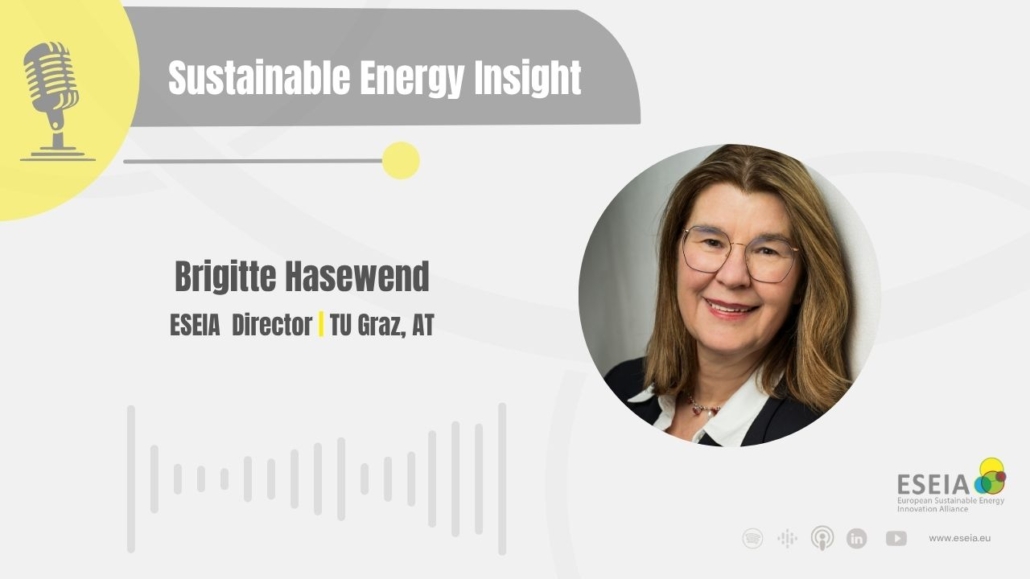
Building Europe’s Energy Innovation Ecosystem: Insights from ESEIA Director Brigitte Hasewend
ESEIA Podcast – Sustainable Energy Insight, Special Edition
The latest episode of the Sustainable Energy Insight Podcast, produced by ESEIA, features a compelling conversation with ESEIA Director Brigitte Hasewend. In this insightful discussion, she reflects on why collaboration across sectors, disciplines, and countries is essential for Europe’s sustainable energy transition. The episode explores the role of innovation ecosystems, the importance of transforming research into market-ready solutions, the future of Framework Programme 10, and how long-term partnerships, capacity building, and international cooperation can strengthen Europe’s competitiveness and accelerate the clean energy transition.
ESEIA: Europe’s energy transition increasingly depends on collaboration across sectors, disciplines, and countries. Why are alliances such as ESEIA becoming essential in this context, and what unique value do they bring that individual organisations cannot achieve alone?
Brigitte Hasewend: We need to understand that we are part of nature’s book: that every breath we take from our first to the last is connected to our environment and that we can only turn things for the better if we respect the atmosphere.
Co-Creation is what we need to set things in motion. We all need to work together across sectors, disciplines, and countries to build a sustainable circular Europe.
This is what ESEIA is about. We founded ESEIA to create sustainable energy solutions for the future. We mobilise researchers, educators, businesses, industry, governments, local innovation ecosystems and connect them on a European scale. We also build partnerships world-wide.
ESEIA: Many European initiatives are organised around time-limited projects. What distinguishes a sustainable innovation ecosystem from a successful project, and how can alliances help maintain momentum, knowledge exchange, and impact beyond project lifecycles?
Brigitte Hasewend: ESEIA was founded in 2009. Today ESEIA has 23 member organisations in 13 countries. ESEIA has created great impact by keeping a memory of and constantly building on past EU funded R&I projects.
350 experts are members of our 5 ESEIA Working Groups. They work on many topics: bioresource utilization pathways including biofuels, urban regional transition pathways, mobility solutions, digital twins of buildings, sustainable urban space, grid systems of the future, sustainable materials for energy storage and energy harvesting.
Horizontal topics include policies, governance and business models, legal frameworks, and social life cycle analysis.
ESEIA also creates impact by building capacity of people and institutions. We fund our own ESEIA Education and Training Programme which has attracted nearly 2,000 people in small high-quality groups.
Finally, ESEIA enhances impact by entertaining partnerships with more than 300 partners in 53 countries world-wide.
ESEIA: As the Lead Expert of SET Plan Task Force 5: Access to the Market, how can Europe better transform research excellence into market-ready solutions that strengthen competitiveness, accelerate the clean energy transition, and ensure that innovation reaches society faster?
Brigitte Hasewend: The Strategic Energy Technology Plan was established to support EU’s energy and climate goals and make Europe a global leader in low-carbon energy and energy efficiency technologies.
What are the barriers for fast market uptake of clean energy solutions? A lot has to do with legal and financial barriers, and questions of governance. To accelerate market access, we need to create favourable framework conditions in Europe. We need to be able to test solutions in a safe pre-competitive environment to get all the support they need to scale up. We need to be able to market our own ideas in Europe. This is an essential element of the European competitiveness strategy. ESEIA has started to support start-ups helping them with funding proposals.
ESEIA: As discussions on FP10 begin to take shape, which changes are most urgently needed to strengthen European competitiveness, support widening countries, and ensure that research and innovation investments generate lasting societal and economic impact?
Brigitte Hasewend: Well, you know, Europe is consistently lagging behind compared to other world regions in innovation performance. And the performance gap is widening. Europe will need to catch up with South Korea, Canada, China, the United States, and Australia. I think the green and digital transitions are a great chance for Europe to build a sustainable circular economy.
Europe will need to increase R&I expenditure (3% GDP) and investments, launch deep reforms AND play the cohesion card.
Framework Programme 10 will be a key driver. In our Position Paper we underlined the role of thematic alliances, global ecosystem partnerships, horizontal topics, and tailored support for transition countries that can perform better.
ESEIA: At the UNITE! Widening Conference in Brussels, you spoke about a transition “From Widening to Transformation.” What does this shift mean in practice, and what changes are needed to ensure that widening efforts lead to lasting institutional, economic, and societal transformation across Europe?
Brigitte Hasewend: Transition countries need incentives to ensure talent retention and upskilling, create favourable framework conditions for R&I, foster interdisciplinary cross-sector collaboration, create permanent and pervasive structures like innovation hubs, and fund long-term partnerships.
ESEIA: Looking ahead, what role do you see ESEIA playing in shaping Europe’s sustainable energy future, and what gives you the greatest reason for optimism about the next decade of the energy transition?
Brigitte Hasewend: I think ESEIA will still have a role to play as a vehicle to ACT, namely to engage and mobilise ecosystems into cocreating, demonstrating, upscaling, replicating, integrating solutions that already exist today.
ESEIA will also definitely work on training people on implementing validated solutions, enhancing their skills, and educating the interested public in our lecture series. We need everyone to contribute.
What makes me hopeful is the fact that we have already come a long way, that we are more and more conscious of the fact that we are part of the solution, that we can do things better if only we try.
Episode available on YouTube and Spotify
___
The ESEIA Sustainable Energy Insight Podcast was created to amplify the voices behind Europe’s sustainable energy transition. Through dynamic interviews, the podcast features ESEIA members, partners, and innovators who share their experiences, achievements, and perspectives on renewable energy, innovation, and policy. Available on YouTube, Spotify.
Subscribe & Follow
Don’t miss an episode — follow us on YouTube, Spotify, and ESEIA Blog to stay connected with the voices shaping Europe’s clean energy future.

