
Key Takeaways from the 19th ESEIA Lecture | Energy System Modelling for Green Africa
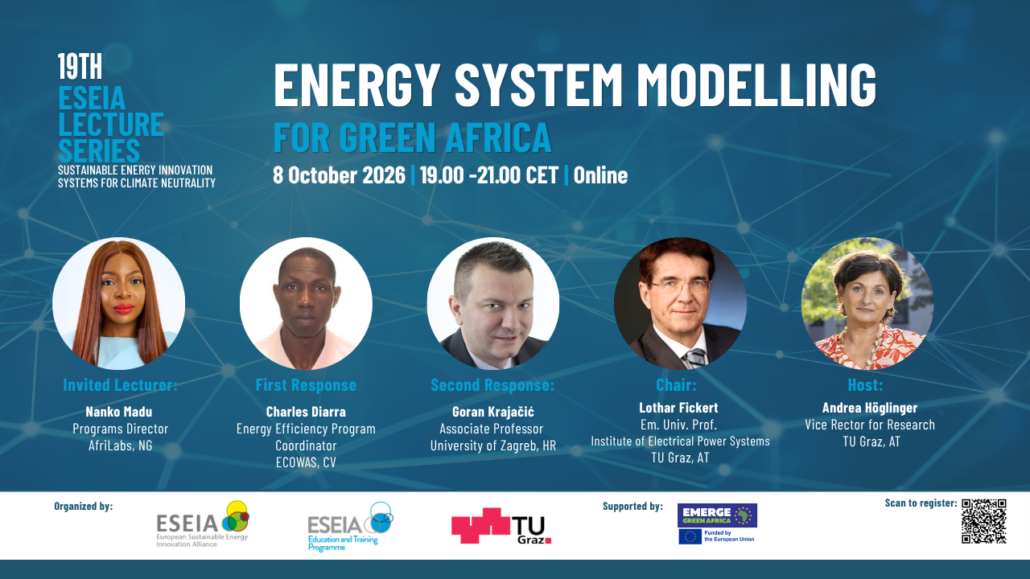
On 8 October 2026, the 19th ESEIA Lecture, “Energy System Modelling for Green Africa”, examined how modelling can support energy planning, investment and wider access to reliable electricity in African contexts. Organised by ESEIA and TU Graz, AT, in cooperation with the EMERGE project, the lecture connected technical tools with the policy, institutional and community needs that shape their use.
Held online, the lecture brought together 57 participants from 20 different countries and featured experts from Africa and Europe with complementary experience across innovation ecosystems, energy efficiency, renewable energy, sustainable development and energy systems.
Welcome statements were delivered by Andrea Höglinger, Vice-Rector for Research at TU Graz and host of the event, and Brigitte Hasewend, ESEIA Director. Lothar Fickert, TU Graz, chaired the session, including the panel discussion, audience Q&A and conclusions.
The invited lecture was delivered by Nanko Madu, Director of Programs at AfriLabs, NG, who leads programmes focused on strengthening Africa’s technology and innovation ecosystem through capacity building for hubs, startups, innovators, SMEs, women and youth.
The discussion continued with responses from Charles Diarra, Coordinator of the Energy Efficiency Program at ECREEE, CV, whose work covers energy efficiency policy, buildings, industry, standards and labels, the water-energy nexus and clean cooking solutions, and Goran Krajačić, Associate Professor at the University of Zagreb, HR, and Vice President of ESEIA, who brings extensive experience in energy and sustainable development and leads ESEIA’s Working Group on Energy Transition in Urban Regions.
Drawing on Africa–Europe collaboration and the EU-funded EMERGE project, the lecture addressed the need for locally relevant energy system modelling tools, stronger modelling capacity, better data, and closer links between modelling outputs, policy implementation and investment strategies.
Key takeaways
· Start with local needs and the decision to be made
Energy planning must reflect the conditions in which solutions will operate. Growing urban and industrial demand, rural electrification, existing grid constraints and climate vulnerabilities raise different questions. EMERGE’s work across Morocco, the Niger River region and Mozambique shows the importance of selecting the right tool for each question and involving local stakeholders in defining it.
· Assess grid capacity and storage together
Renewable energy deployment needs to be considered alongside the network’s ability to accommodate it. Madu illustrated this through an EMERGE simulation of a constrained Mozambique network: adding two batteries reduced renewable energy curtailment by 34.8% and redispatching costs by 60.6% compared with the simulated scenario without batteries. These results concern the specific modelled case and demonstrate how modelling can help evaluate the potential value of storage before investment.
· Link technical analysis with policy and investment
Modelling can help policymakers examine infrastructure and flexibility needs before committing public resources, while giving investors a clearer view of grid constraints and potential opportunities. Diarra’s contribution reinforced that implementation also requires clear institutional responsibilities, credible regulatory frameworks, financing mechanisms and capacity building.
· Build local ownership through cooperation and innovation
Madu highlighted the complementary contributions of African and European partners: technical modelling expertise alongside knowledge of local systems, institutions and communities. Co-design, open-source tools and capacity building can enable African actors to use and adapt the outputs. AfriLabs’ work connects research with innovation hubs, entrepreneurs and communities through hackathons, pilot demonstrations and the Research and Innovation and Policy Laboratory. These activities create pathways for modelling insights to inform policy recommendations and new products and services.
· Keeping the tools and partnerships in use
With EMERGE formally concluding in November 2026, Madu identified continuity as a priority: keeping the open-source tools, Knowledge Base and partnerships in active use by institutions, universities, utilities and innovators. Building an African community of practice around energy system analysis offers a way to carry this work forward.
The lecture highlighted the value of modelling when it is connected to a clearly defined decision, informed by local knowledge and supported by the capacity to put its findings into practice.
Watch the invited lecture:
Nanko Madu, Director of Programs at AfriLabs, NG
Watch the 1st Response:
Charles Diarra, Coordinator of the Energy Efficiency Program at ECREEE, CV
Watch the 2nd Response:
Goran Krajačić, Associate Professor at the University of Zagreb, HR, and Vice President of ESEIA
For further insights on Europe – Africa cooperation and energy modelling read our interview in the ESEIA Sustainable Energy Insight series with Prof. Smail Zouggar, Full Professor of Electrical Engineering at Mohamed Premier University (UMP) in Oujda, Morocco, who reflects on the opportunities and challenges shaping Morocco’s energy transition: https://eseia.eu/news/eseia-sustainable-energy-insight-in-focus-building-resilient-energy-systems-through-eu-africa-cooperation/

