
INITIATE Knowledge Exchange: ESEIA Hosts Two Study Visits in Graz, AT
The INITIATE Knowledge Exchange Programme continued to foster institutional collaboration through staff mobility, with ESEIA hosting two study exchanges at its office in Graz, AT.
From 8–19 June 2026, Maria Covei, researcher and lecturer at Transilvania University of Brașov (UTBv), RO, completed a two-week study exchange at the ESEIA Office. During her visit, she contributed to proposal development, dissemination activities, expert database updates and collaboration initiatives, while gaining first-hand experience of ESEIA’s Working Groups, communication activities and stakeholder engagement. The exchange also identified new opportunities for future cooperation between ESEIA and UTBv, including expanding ESEIA’s network in Romania and developing joint project proposals.
A second study exchange hosted researcher Ioanna Kyprianou from The Cyprus Institute, CY, further strengthening collaboration within the consortium and promoting the exchange of expertise on research excellence, institutional transformation and sustainable energy innovation.
Together, these activities demonstrate ESEIA’s continued commitment to strengthening research excellence, institutional transformation and long-term collaboration across the European Research Area.
Following her stay in Graz, we spoke with Maria about her motivation for joining the exchange, her experience working alongside the ESEIA team, and the perspectives she is taking back to UTBv. Read the full interview below.
ESEIA: What motivated you to take part in this staff exchange at ESEIA, and what were you most looking forward to?
Maria Covei: The main reason for taking part in this staff exchange at ESEIA, and what I was most looking forward to, was the opportunity to step outside my usual academic environment and experience how a European association operates on a daily basis. As a researcher and lecturer, most of my work is connected to universities and research projects, so I was curious to see how ESEIA builds collaborations between academia, industry and other stakeholders across Europe (and beyond, as it turns out).
Another factor that contributed to this decision was broadening my expertise beyond my main research field, which is sustainable water management. Energy transition and energy communities are becoming increasingly connected to environmental sustainability, so this exchange was an opportunity to better understand this connection.
Also, I was really looking forward to meeting the team in person. We had already crossed paths on a few occasions thanks to the INITIATE project (in the frame of which this visit has taken place) and we had also collaborated remotely, but spending two weeks working alongside them offered a completely different perspective (not only on the projects themselves, but also on how ideas are developed, partnerships are built and everyday work happens within an international organization).
ESEIA: Looking back on your two weeks at ESEIA, what has been the most valuable experience or takeaway, and why?
Maria Covei: Looking back, the most valuable part of the exchange was the opportunity to experience ESEIA from the inside. Working alongside the team gave me a much better appreciation of the amount of coordination, communication and relationship-building that takes place behind the scenes to support international collaboration.
One thing that impressed me was the team’s openness. Despite having a busy schedule, everyone was willing to explain their work, answer questions and involve me in discussions. That created a welcoming environment and made it easy to understand not only what ESEIA does, but also how it works as an organization.
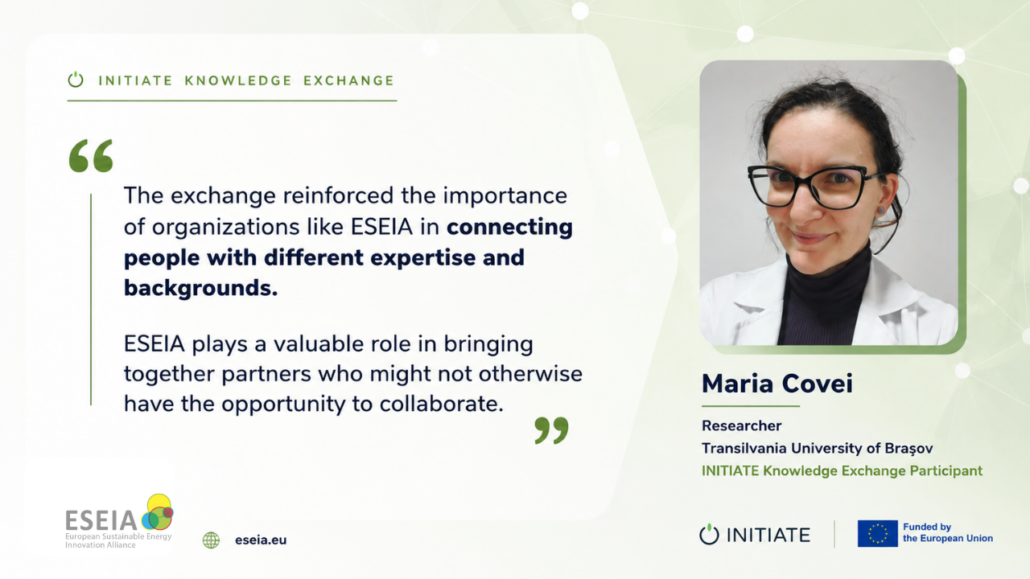
The exchange also reinforced the importance of organizations like ESEIA in connecting people with different expertise and backgrounds. Universities often focus on their own research and teaching activities, whereas ESEIA plays a valuable role in bringing together partners who might not otherwise have the opportunity to collaborate. Seeing that process first-hand was probably my biggest takeaway from the visit and I am very grateful to both ESEIA and the INITIATE project for giving me this opportunity.
ESEIA: What new ideas, knowledge, or skills will you take back with you to UTBv?
Maria Covei: I don’t think I can say that I returned to UTBv with a completely new set of technical skills, but that wasn’t really the purpose of this visit anyway. Instead, I’ll take back a different perspective on the human side of international collaboration.
The biggest thing I’m taking back is a better understanding of what makes international collaborations work: not just projects, but the people behind them. Spending two weeks with the ESEIA team reminded me that openness and day-to-day interactions are just as important as expertise. That’s something I’ll certainly carry into my future collaborations.
Secondly, I came away with an even greater appreciation of the commitment required to keep a small international organization running. Many of the activities people see externally are supported by extensive coordination and ongoing work behind the scenes.
The exchange also gave me time to reflect on my own way of working and on what I value in a professional environment. Experiencing another organization from the inside reinforced the importance of meaningful work and of being part of a team where people enjoy working together and support one another. I think those reflections are just as valuable as any technical knowledge I could have gained during two weeks abroad.
ESEIA: How do you think this exchange will help strengthen the collaboration between UTBv and ESEIA in the future?
Maria Covei: I think this knowledge exchange has already strengthened the collaboration in a very practical way. Spending two weeks working together has made it much easier to understand each other’s strengths, priorities and ways of working. That shared understanding creates a stronger foundation for future initiatives than online meetings can provide on their own.
I also think that this visit helped to identify several concrete opportunities for collaboration. These include expanding ESEIA’s network in Romania by connecting with universities and research institutes with complementary expertise, developing joint project proposals, and creating new opportunities for staff and student engagement through knowledge exchange activities. We also look forward to any study or knowledge visits from ESEIA members to UTBv in the near or distant future.
ESEIA: What would you say to other researchers considering participating in an international staff exchange?
Maria Covei: Oh, I would definitely encourage them to take the opportunity of an exchange visit. Even if you’ve been involved in a lot of international projects before, spending time working within another organization gives you a completely different perspective than collaborating remotely. You gain a much better understanding of how people work, how decisions are made, and what the driving factors are for different organizations.
A staff exchange is also a chance to build connections that go beyond formal project meetings. Sharing everyday work, discussing ideas sometimes informally and getting to know colleagues in their own working environment creates a human connection, and that connection often becomes the foundation for future collaborations.
If the opportunity is with an organization like ESEIA, I’d especially encourage researchers to participate. Universities and research institutes each have their own perspective, while organizations like ESEIA work across institutions, sectors, and countries. Experiencing that broader perspective can be extremely valuable: not because it replaces academic expertise, but because it complements it.
Finally, my advice would be to approach the exchange with an open mind. Don’t focus only on your own objectives. Instead, take the time to observe, ask questions, and understand how the host organization operates. Even if the experience challenges some of your expectations, those insights are often the most valuable ones to bring back home.

