
From Compliance to Conviction: What Drives Companies Toward a Circular Economy
Selected highlight of this edition of the ESEIA Sustainable Energy Insight series.
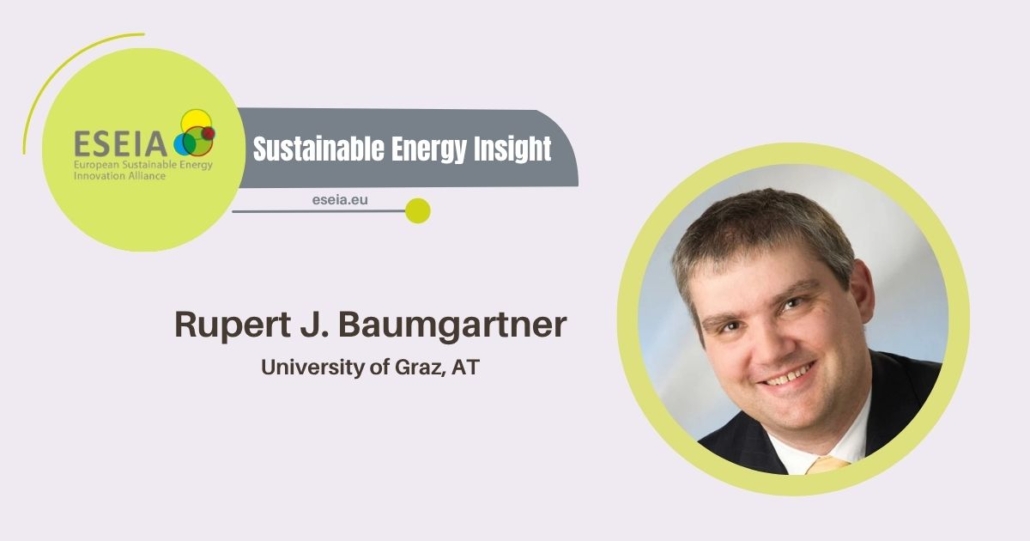
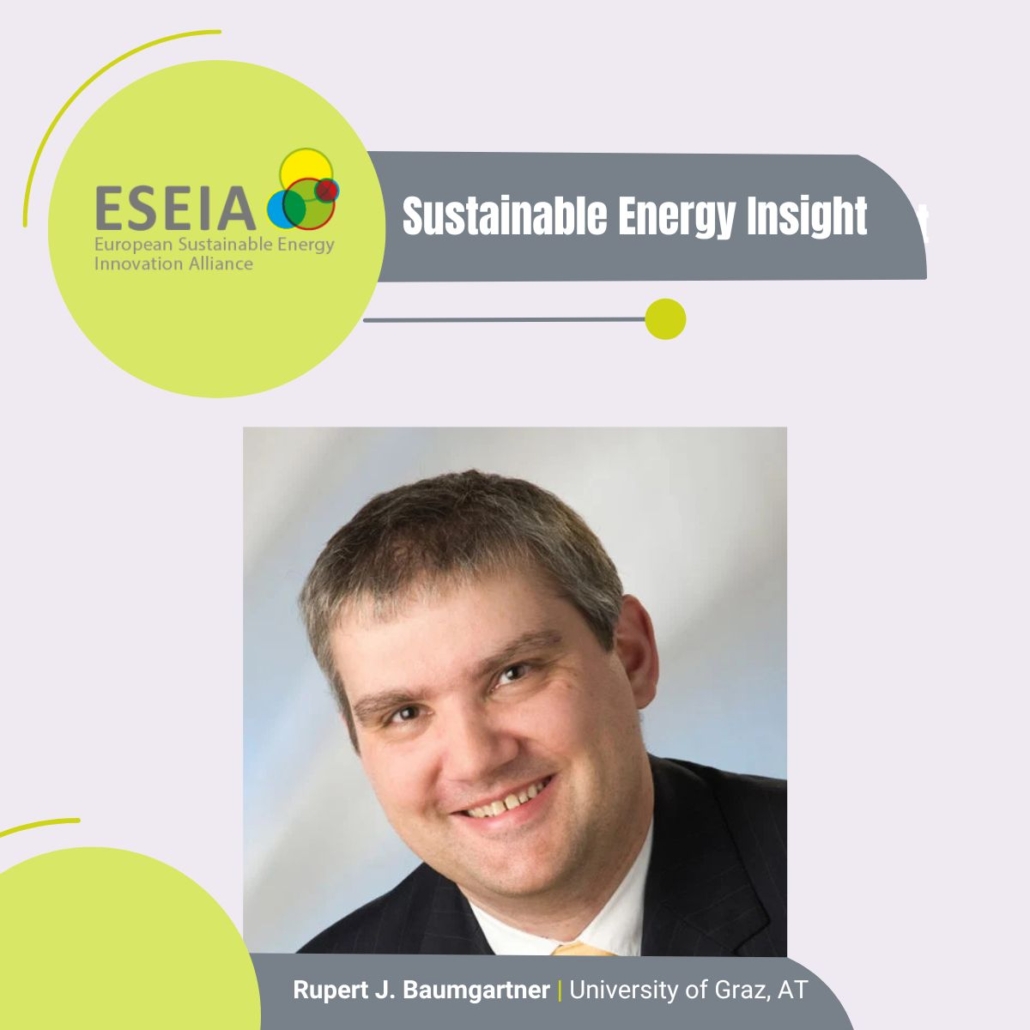
The circular economy sits at the heart of Europe’s sustainability transition, and ESEIA member University of Graz, AT is contributing meaningfully to that conversation, through the research of Rupert J. Baumgartner, Professor for Sustainability Management at the Department of Environmental Systems Sciences (ESS). Because moving from theory to practice is where the real work begins.
Rupert Baumgartner studies how companies and their products and services can make a real and meaningful contribution to sustainable development. Companies need to follow a radical vision for sustainability, this vision is translated into strategic goals and executed in business models. Sustainable companies deliver values for society and nature and for themselves.
In January 2026, Baumgartner joined colleagues Pauline Deutz, Sandra Careiro, Roberta Salomone, and Tomás B. Ramos at the international seminar in Lisbon titled “Critical Challenges for Transforming Society for a Circular Economy”. The event marked the official Portuguese launch of their co-authored book Circular Economy Realities: Critical Perspectives on Sustainability (Routledge, 2025), a key outcome of the CRESTING project (Circular Economy: Sustainability Implications and Guiding Progress), an EU Horizon 2020 Marie Skłodowska-Curie Innovative Training Network bringing together eight European universities and partners across Africa and Asia.
The research findings reached a wide audience when the team appeared on BIOSFERA, the sustainability programme of RTP, Portugal’s national public television broadcaster. In the episode, Baumgartner offered a clear framework for understanding what motivates companies to act:
“Basically, we see three different motivations for companies to do something for sustainability and for circularity. One is legal pressure, European initiatives like the Green Deal or the circular economy package are forcing companies to a minimum level. Then we see opportunistic companies: if you do it in the right way you can have better value creation, you can be better off economically. And there are companies, the minority, with intrinsic motivation: they want to contribute to a better world, they want to solve the sustainability crisis we observe currently.” — Rupert J. Baumgartner, Professor for Sustainability Management, Department of Environmental Systems Sciences (ESS), University of Graz, AT
This three-tier framework, regulatory compliance, economic opportunity, and intrinsic purpose, reflects the broader thesis of” Circular Economy Realities”: the circular economy does not deliver its benefits automatically. Understanding what drives a given company is essential to designing the right policy instruments, partnerships, and incentive structures.
Watch the BIOSFERA episode on RTP Play
(Biosfera Episódio 6 – 21 Feb 2026)
From November 2018 to April 2026, Baumgartner has also directed the Christian-Doppler-Research Laboratory for Sustainable Product Management, enabling a Circular Economy at the University of Graz, where his team developed frameworks that help companies embed circularity as a source of lasting competitive and societal value, not merely a compliance exercise.
”Circular Economy Realities” is available via Routledge . Watch the BIOSFERA episode on RTP Play
Further resources:
- Circular Economy Realities: Critical Perspectives on Sustainability, edited by Pauline Deutz, Walter J.V. Vermeulen, Rupert J. Baumgartner, Tomás B. Ramos, and Andrea Raggi (Routledge, 2025): https://www.routledge.com/Circular-Economy-Realities-Critical-Perspectives-on-Sustainability/Deutz-Vermeulen-Baumgartner-Ramos-Raggi/p/book/9781032281810
- CRESTING project website: https://cresting.hull.ac.uk
- BIOSFERA episode on circular economy (RTP, Portugal): https://www.rtp.pt/play/p16211/e910361/biosfera (link via Rupert J. Baumgartner’s LinkedIn post)
Rupert J. Baumgartner at University of Graz:
Profiles:
Google Scholar | LinkedIn | Academia.edu
About the ESEIA Sustainable Energy Insight series
The ESEIA Sustainable Energy Insight series (blog and podcast) is designed as a vibrant platform that informs, engages, and inspires sustainable energy experts. It serves as a knowledge hub for ESEIA members, partners, and stakeholders, offering regular insights into projects, achievements, and emerging opportunities in the renewable energy sector.
Interested in contributing? Share your insights through interviews, expert opinions, or project highlights. For more details or to contribute, contact us at office@eseia.eu and nicoleta.talpes@eseia.eu.

