

Advancing Climate Mitigation Through Circular Economy: ESEIA Member LNEG’s Role in the CO2NSTRUCT Project
As a proud member of the European Sustainable Energy Innovation Alliance (ESEIA), the National Laboratory for Energy and Geology (LNEG) in Portugal is at the forefront of innovative research aimed at achieving a carbon-neutral Europe. One of its key contributions is through the CO2NSTRUCT project, a groundbreaking initiative dedicated to integrating circular economy (CE) principles into the construction materials value chain to enhance climate mitigation efforts.
Transforming the Construction Industry with Circular Economy
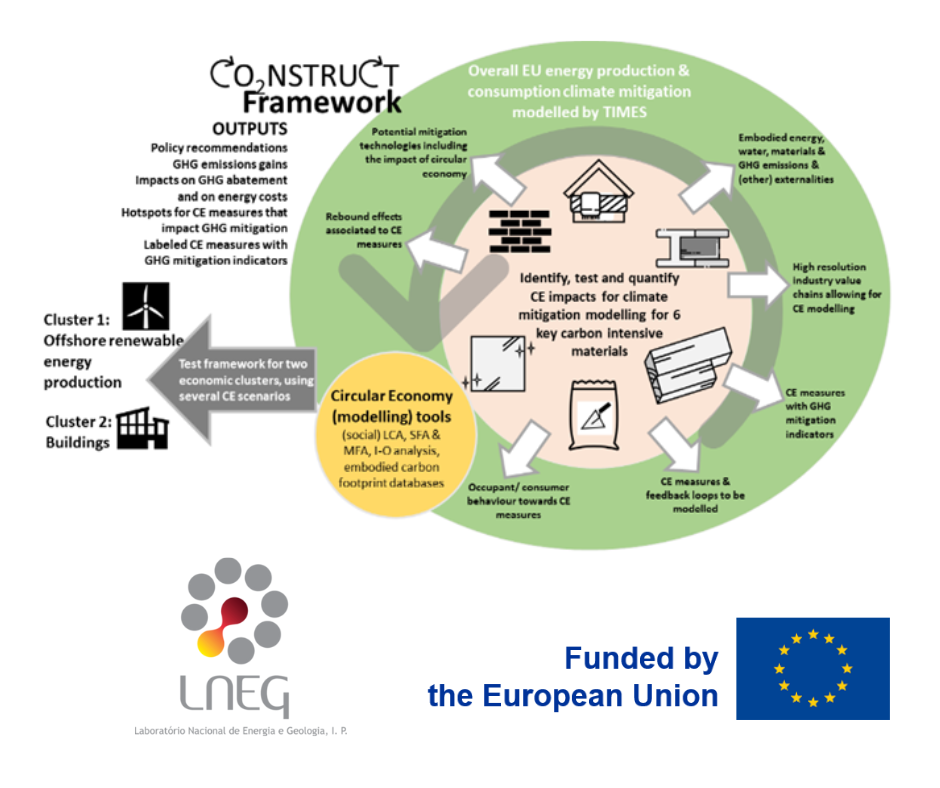
The CO2NSTRUCT project addresses one of Europe’s most pressing challenges: decarbonizing the construction sector. It aims to develop a cutting-edge climate mitigation modelling framework that incorporates CE feedback loops, assesses their rebound effects, engages citizens, and evaluates externalities across multiple CE climate mitigation scenarios.
Focusing on six critical, carbon-intensive construction materials—steel, cement, brick, glass, wood, and insulation—the project will map their value chains with explicit feedback loops and quantify rebound effects. These practices will account for social and environmental externalities, including greenhouse gas (GHG) and air pollutant emissions, water usage, embodied energy, energy poverty, employment, and inequalities.
Innovative Tools for Effective Climate Action
To achieve its objectives, CO2NSTRUCT integrates life cycle assessment (LCA) and material flow analysis (MFA) tools into the TIMES model, a widely recognized tool for energy system analysis. TIMES will simulate various circular economy scenarios, quantifying their role in EU+ climate mitigation in both the near and long term. The outcomes of these simulations will provide actionable insights for policymakers, empowering them with effective strategies to advance sustainable climate mitigation.
Collaborative Effort for Greater Impact
The CO2NSTRUCT project brings together leading organizations across Europe, including:
- Danmarks Tekniske Universitet (DTU)
- Centre for Renewable Energy Sources and Saving Fondation (CRES)
- Ruhr-Universitaet Bochum (RUB)
- Centro de Investigaciones Energeticas, Medioambientales Y Tecnologicas (CIEMAT)
- Universita di Pisa (UNIPI)
- The University of Sheffield (USFD)
This robust partnership underscores the project’s multidisciplinary approach and commitment to driving transformative change across Europe.
Expected Impact
CO2NSTRUCT is poised to make significant contributions to climate action by:
- Quantifying the impact and potential of circular economy practices for mitigating climate change.
- Supporting the integration of circular economy principles into climate policies, enhancing their evidence base, and accounting for externalities.
- Incorporating GHG emission reduction into circular economy criteria, ensuring that CE strategies align with broader climate goals.
Looking Ahead
With LNEG’s leadership, the CO2NSTRUCT project exemplifies the power of cross-sector partnerships in tackling climate challenges. The outcomes will not only provide innovative tools for sustainable construction practices but also pave the way for a more circular, equitable, and climate-resilient future.
For more information, visit: https://co2nstruct.dtu.dk/
Contact: Juliana Barbosa (juliana.barbosa@lneg.pt); Sofia Simões (sofia.simoes@lneg.pt)