

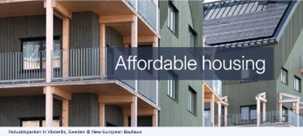
Accelerating Solutions for Affordable and Sustainable Housing in Europe
Europe is experiencing a housing affordability crisis, driven by rising construction costs, limited housing availability, and the need to meet ambitious climate and energy efficiency targets. Commission President Ursula von der Leyen named the urgent need to make housing affordable a social crisis in her State of the European Union speech and emphasised that coordinated action is required. [1]
In response to this urgent need, the European Affordable Housing Plan, supported by several complementary EU initiatives, aims to mobilise investment, strengthen cooperation among Member States, and encourage innovation to make sustainable, high-quality housing accessible to all. [2]
The European Commission presented the Affordable Housing Plan on 16 December 2025, focusing on affordability without compromising sustainability. It is based on 4 pillars: Boosting Housing Supply, Mobilising Investment, Enabling Immediate Support While Driving Reforms, and Protecting The Most Affected. While housing policy remains the responsibility of individual Member States, the EU will provide guidance, facilitate the sharing of best practices, and support dissemination activities. In 2026, a Housing Alliance will be launched, bringing together Member States, housing cooperatives, academia, and industry. A new European Construction Strategy will complement the plan by promoting circular construction, renovation and repurposing of buildings, reducing regional differences in implementation capacity and advancing the digitalisation of permitting processes. [5] [6]
In parallel, the Commission will strengthen the role of the New European Bauhaus to support sustainable, inclusive, and community-oriented living environments. [3]
The challenges addressed by the European Affordable Housing Plan were also at the core of the 15th ESEIA Lecture Series,“Making Housing More Affordable: How can the New European Bauhaus help?”, held on 9 October 2025, which explored how Europe can reconcile housing affordability with decarbonisation objectives. The insights from this discussion closely mirror the policy priorities now emerging at the EU level.
Looking ahead, 2026 will further see the launch of a Pan-European Investment Platform, supported by the European Investment Bank, to channel public and private capital into affordable, sustainable housing projects. A Housing Summit and Citizens’ Dialogue in the second half of 2026 will promote knowledge exchange and dissemination across Europe. [4]
ESEIA will continue to collaborate actively with European Institutions, contributing expertise from its member network and promoting the dissemination of the Affordable Housing Plan across Europe. Through such strong collaboration and shared knowledge, ESEIA aims to accelerate the transition to sustainable, affordable housing for all European citizens.
Sources:
[1] President’s State of the Union speech addresses the housing crisis – Housing (europa.eu)
[2] What the EU does – Housing – European Commission (europa.eu)
[3] New European Bauhaus – achievements and future developments (communication) (europa.eu)
[4] New pan-European investment platform for affordable and sustainable housing (europa.eu)
[5] The European Affordable Housing Plan – Housing – European Commission

