
RUNNING COURSES
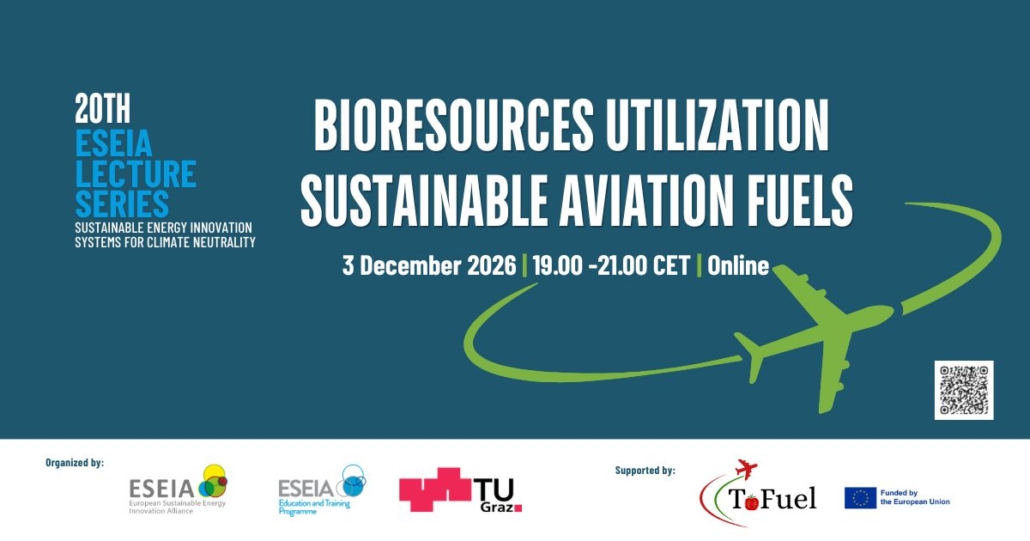
20th ESEIA Lecture
Bioresources Utilization: Sustainable Aviation Fuels
3 December 2026 | 19.00-21.00 CET | Online
Abstract: Aviation is responsible for over 2% of global CO₂ emissions, and decarbonising it is challenging. Sustainable Aviation Fuels (SAF) offer the most promising near‑term solution – but can bioresources deliver at scale without competing with food and feed production or natural ecosystems?
This lecture examines feedstock availability, key conversion technologies, lifecycle emissions, and the economic realities of scaling up. We also explore the policy frameworks and innovation ecosystems needed to move SAF from pilot projects to commercial reality. The EU ToFuel project, which converts tomato waste into SAF, serves as a concrete example of regional circular bioresource utilisation.
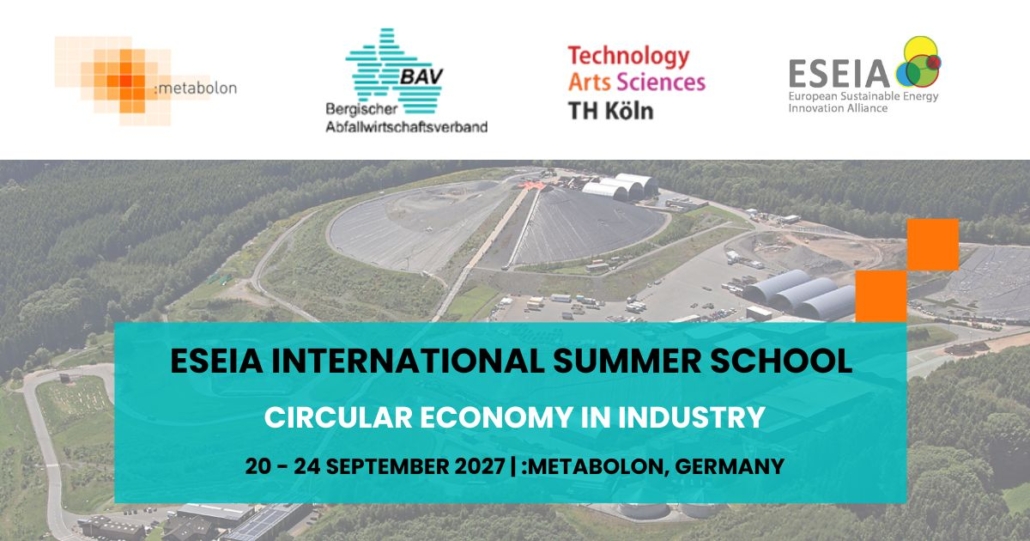
ESEIA International Summer School 2027
Circular Economy in Industry
20–24 September 2027 | :metabolon, Lindlar, Germay
The ESEIA International Summer School 2027 will offer a balanced mix of lectures, hands-on workshops, group work, and site visits, all designed to deepen understanding and stimulate cross-sector dialogue on the circular economy. Topics will include:
- Industrial waste valorisation
- Biogas technologies and leachate treatment
- Business models and legal frameworks for circularity
- Spatial and aesthetic considerations, including the integration of Bauhaus design principles
- User acceptance and socio-economic implications of circular practices
Participants will have the opportunity to engage directly with experts in the field and explore pilot-scale facilities at :metabolon, including those for fermentation, hydrothermal carbonisation, and gasification.
Structure and Teaching Methods
The programme is delivered entirely on site and includes:
- Expert lectures and team-teaching by interdisciplinary faculty
- Supervised group work and project development
- Technical site inspections and guided exploration of :metabolon
- Final group presentations and feedback sessions
This immersive structure is designed to foster collaboration, critical thinking, and practical application of concepts.
Registration
To register, please contact: schmidt@bavmail.de