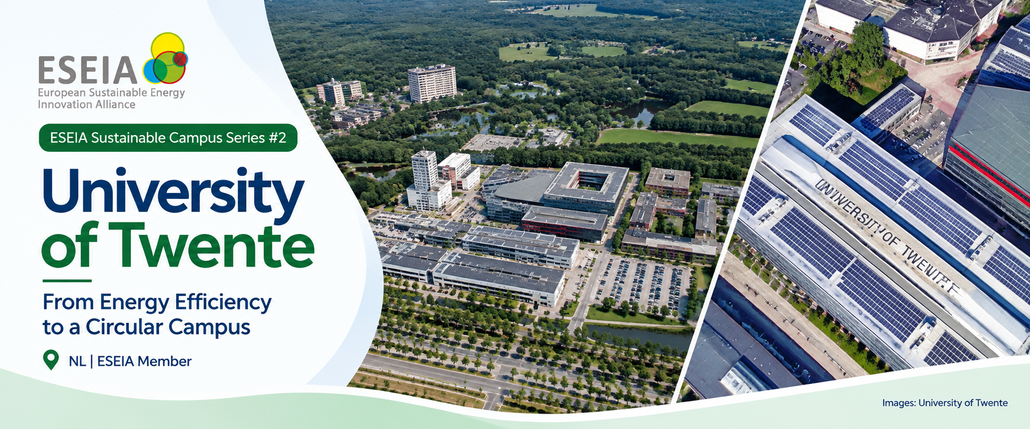

ESEIA Sustainable Campus Series: University of Twente, NL
A Campus-Wide Roadmap from Energy Efficiency to Circularity
How can an entire university campus be approached as one interconnected energy and sustainability system? In this article of the ESEIA Sustainable Campus Series, we look at the University of Twente, NL, where building renovation, district heating, large-scale cooling, solar energy and long-term infrastructure planning are being combined within a campus-wide transition.
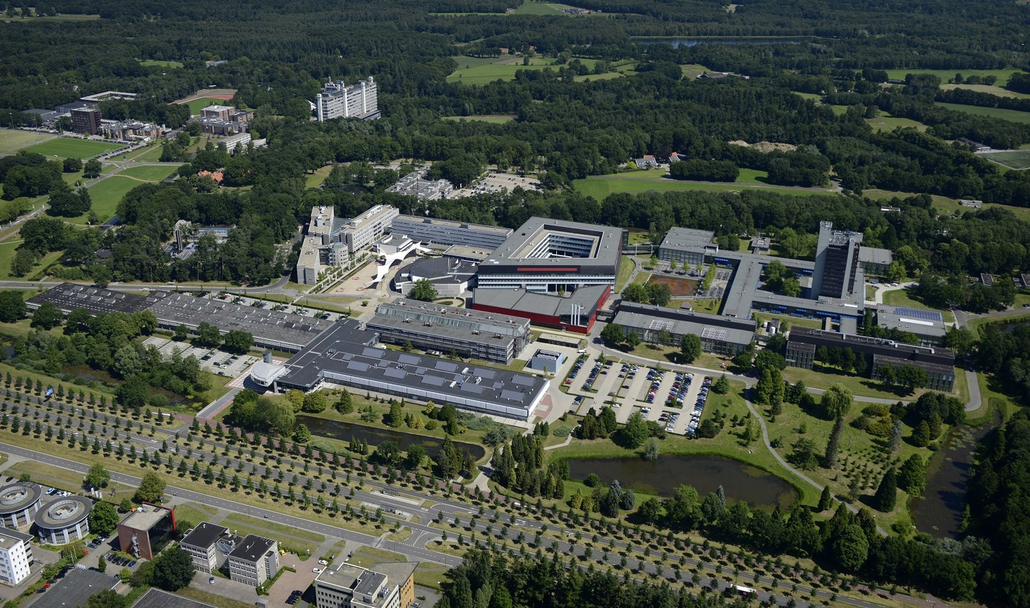
Image: Langezijds at the University of Twente – one of the most sustainable buildings on campus.
Source: University of Twente, Sustainability Walk – Langezijds.
The University of Twente approaches sustainability as a university-wide operational challenge. Through its Sustainability, Energy & Environment (SEE) programme, launched in 2019, the university works to reduce carbon emissions and the consumption of energy and raw materials, while integrating sustainability into the way the campus is managed. UT has set long-term ambitions for a carbon-neutral campus by 2030 and a carbon-negative campus by 2050, alongside wider goals for a waste-free campus by 2030 and a fully circular campus by 2050. In 2026, the university began updating its sustainability policy and developing a new roadmap to translate these ambitions into concrete steps and milestones.
Buildings are central to the transition because they account for most of the energy used by the university. Rather than addressing them individually, the University of Twente has developed an energy roadmap for around 60 campus buildings, assessing which measures can still be implemented, their potential energy savings and the associated costs.
The roadmap is linked to the university’s long-term housing strategy and aims to support a 49% reduction in CO₂ emissions from buildings by 2030 and 95% by 2050. It is also intended to remain dynamic: UT states that the roadmap is reviewed regularly to incorporate new technologies and emerging best practices.
This means that renovation and new construction are treated as part of the same long-term transition. The university uses sustainability requirements in its building projects, including energy performance, connection to shared energy infrastructure and consideration of materials and their potential for reuse.
Langezijds: transforming an existing building
One of the clearest examples is Langezijds, the home of the University of Twente’s Faculty of Geo-Information Science and Earth Observation (ITC). Rather than replacing the former engineering building, UT transformed it into a 13,783 m² teaching and research facility, improving its energy label from G to A+++. Parts of the existing steel and concrete structure were retained, while almost 1,000 photovoltaic panels were installed on the roof.
The renovation also integrates environmental quality and biodiversity. Three large atriums bring greenery, daylight and fresh air into the building and create habitats for flora and fauna. Rainwater is stored in infiltration crates and reused for drip irrigation in the courtyard gardens. The result connects energy performance and material reuse with a broader approach to the quality and resilience of the built environment.
Heating and cooling as shared campus infrastructure
The University of Twente also demonstrates how the sustainability of individual buildings can depend on infrastructure operating at campus scale. Most campus buildings are connected to a district heating network using residual heat from Twence, reducing reliance on individual fossil-fuel heating systems. The university continues to phase buildings away from natural gas as part of its energy strategy. Cooling is provided through another shared solution: UT’s Cool Circle. The system consists of a reservoir holding more than 10 million litres of cold water, which is cooled mainly at night and then circulated to connected buildings and research equipment during the day.
The temperature difference between the cold and returning warm water creates a thermocline that keeps the layers separated, enabling the water to function as a large thermal buffer. The system has a cooling capacity of 11 MW and serves a growing group of university buildings. The Cool Circle illustrates an important aspect of campus-scale sustainability: instead of installing separate cooling systems on every building, shared infrastructure can provide a more integrated solution across the estate.
Expanding renewable electricity and reducing gas use
Renewable electricity generation is another part of the campus strategy. By the end of 2025, the University of Twente reported 3,019 solar panels across the campus, including 955 panels installed on the Carré building that year. Together, the campus photovoltaic systems generated electricity equivalent to around 3.2% of UT’s annual electricity consumption.
At the same time, the university continues to move buildings away from natural gas. In 2025, gas consumption was 50% lower than in the 2019 baseline year. UT notes, however, that this figure should not be interpreted simply as a reduction in total energy demand, because part of the decrease results from buildings being transferred from gas to district heating.
Monitoring is another element of the approach. The University of Twente operates a public Energy Data Platform that makes campus energy-consumption data accessible and invites students and researchers to analyse it and identify opportunities for further energy savings.
This connects operational management with the university’s education and research environment: campus performance itself becomes a source of data that can be investigated and used to improve future decisions.
The transition is continuing to evolve. In 2026, UT began updating the policy framework of its SEE programme and developing a new roadmap focused on how its long-term sustainability ambitions can be translated into practical action over the coming years. The process includes staff, students and researchers and links the energy transition with broader objectives: a waste-free campus by 2030, a fully circular campus by 2050, and the university’s long-term carbon ambitions.
The University of Twente example shows that improving campus sustainability is not simply a matter of adding photovoltaic panels or renovating individual buildings.
Source: https://www.utwente.nl/en/sustainability/