
Sustainable Energy Insight | In focus: Building Resilient Energy Systems through EU–Africa Cooperation
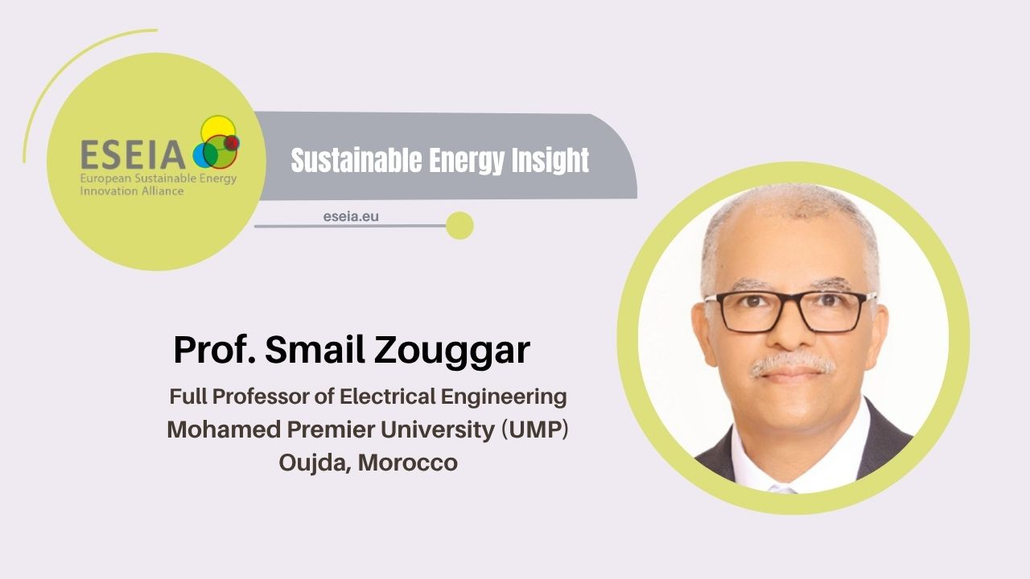
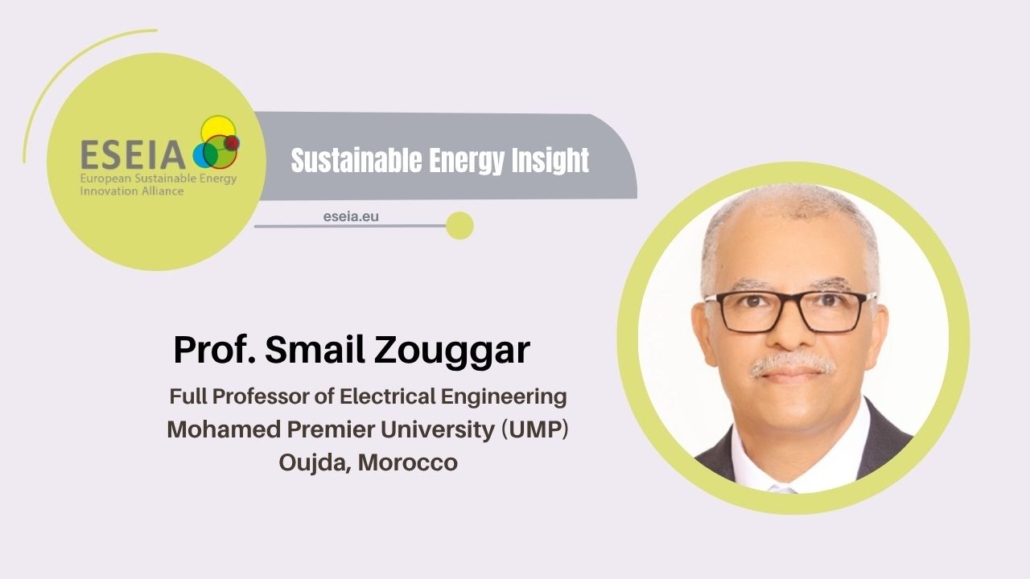
In this edition of ESEIA Sustainable Energy Insight, Prof. Smail Zouggar, Full Professor of Electrical Engineering at Mohamed Premier University (UMP) in Oujda, Morocco, reflects on the opportunities and challenges shaping Morocco’s energy transition. Drawing on the experience of the EMERGE project, he discusses the need for resilient and flexible energy systems, the importance of adapting energy modelling to local realities, and how EU–Africa cooperation can evolve into a genuine two-way exchange of knowledge and innovation. The interview also looks beyond the project itself, exploring what is needed to turn research tools, expertise and partnerships into lasting resources for energy planning across Africa.
Blog Edition
Read the interview in:
ENGLISH | FRANÇAIS (original interview)
Guest: Prof. Smail Zouggar, Full Professor of Electrical Engineering, Mohamed Premier University (UMP), Oujda, Morocco
ESEIA: Morocco has made considerable progress in renewable energy, but its energy system is also facing growing demand, increased electrification and a need for greater flexibility. In your view, what is the most important challenge Morocco must address today to build a resilient energy system towards 2030 and beyond?
Prof. Smail Zouggar: Morocco’s energy system is facing growing demand, increasing from 18.7 million tonnes of oil equivalent (Mtoe) in 2014 to 25 Mtoe in 2024, an increase of 33.7%. The electricity access rate, which stood at 97.3% in 2014, is expected to reach nearly 100% in 2026.
In 2009, Morocco adopted an energy strategy focused primarily on renewable energy, the development of energy efficiency and stronger regional integration.
Implemented through programmes with clearly defined objectives and supported by targeted legislative and institutional reforms, this strategy has demonstrated its effectiveness and relevance, enabling Morocco to become a producer of renewable energy, whereas it had previously been entirely dependent on imports to meet its fossil fuel needs.
Morocco aims to increase the share of renewable energy in its installed electricity generation capacity to more than 52% by 2030, 78% by 2040 and 87% by 2050. This new strategy seeks to harness the potential of solar, wind and hydropower, while also exploring new energy sources such as waste-to-energy through biomass and hydrogen.
This vision is beginning to deliver results. Morocco has already demonstrated its capacity to build large-scale renewable energy generation facilities, with Noor Ouarzazate providing an example. The country’s energy dependency rate decreased from 94.6% in 2014 to 87.5% in 2024.
Yet beyond this impressive green energy production, Morocco’s energy system requires greater flexibility to manage the intermittency of renewable energy sources, secure supply in the face of rising peak demand — around 7,620 MW in 2024 — and accommodate net electricity demand of 45,698 GWh, an installed capacity of 12,016 MW and a 45.30% share of renewable energy in installed capacity in 2024, while smoothly integrating the target of more than 52% renewable capacity by 2030.
The key to greater flexibility in Morocco towards 2030 lies in coordinated action across several areas:
- Developing pumped-storage hydropower, high-capacity batteries and green hydrogen;
- Modernising the grid through smart and digitalised operation, enabling real-time responses to variability;
- Improving gas infrastructure and peak thermal generation: natural gas is an essential and readily available back-up source that can respond rapidly to peaks in demand, particularly in the early evening;
- Strengthening interconnections with neighbouring grids, enabling Morocco to export surplus renewable energy and import balancing capacity when required;
- Promoting self-generation and smart grids.
Morocco therefore faces a complex challenge: how to integrate an ever-growing share of renewable energy sources while maintaining a stable, reliable and competitive electricity supply. This represents the central challenge of its energy strategy.
ESEIA: EMERGE is based on the co-design of energy models that reflect African technical, economic, environmental and social realities. What has the pilot project in Morocco taught you about the specific characteristics that energy modelling in Africa needs to incorporate?
Prof. Smail Zouggar: One of the main lessons from Morocco’s experience with the EMERGE project is that a model developed in a European context cannot simply be transferred unchanged to another institutional, economic or energy environment, regardless of how technologically advanced it may be. Its value depends first and foremost on its ability to adapt to the specific characteristics of the context in which it is implemented.
Four main lessons can be drawn.
The first concerns data. In Morocco, energy data may be less detailed than the data generally available in European countries. Modelling tools must therefore be able to work with incomplete or heterogeneous data and, above all, highlight the associated uncertainties. Transparency regarding data limitations is therefore essential to ensuring reliable results.
The second lesson concerns the integration of socio-economic dimensions. Energy demand is determined not only by technical standards but also by subsidy mechanisms, household purchasing power, geographical dynamics and the close links between the water and energy sectors, particularly through desalination and irrigation pumping. Taking these interconnections into account is essential for developing realistic and appropriate public policy scenarios.
The third lesson, probably the most important, concerns local ownership. Co-designing models in collaboration with public bodies, regulatory organisations, government agencies, universities and research centres is not simply a participatory exercise; it is essential to the credibility, usefulness and effectiveness of the tools. When local stakeholders recognise their operational constraints and realities on the ground within the model, they are more likely to critically assess its results, contribute to its improvement and, above all, integrate it into their decision-making processes.
The fourth lesson concerns adapting the model to policy barriers and opportunities. Analysing regulatory frameworks and policy barriers is a crucial stage of the project. The Moroccan case has demonstrated that creating technical tools is not enough; understanding and integrating the policy context is equally important in order to formulate relevant recommendations. Specific deliverables have been developed to identify these barriers and propose appropriate courses of action for each participating country, including Morocco.
This experience leads to a broader conclusion: energy modelling should be designed not only as an instrument for analysis and scenario development, but also as a means of strengthening local capacities.
The performance of a model therefore depends not only on its technical sophistication, but also on the quality of the data, understanding of the context and the skills available to use, interpret and further develop it. The model and the local expertise supporting it must therefore evolve together in order to become a genuine decision-support tool for the energy transition.
ESEIA: EMERGE is built around EU–Africa cooperation. From your perspective in Oujda, what makes this a genuinely two-way partnership rather than simply a transfer of European tools and expertise? And what should European partners learn from the African pilot sites?
Prof. Smail Zouggar: European partners learn from African contexts. The African pilot sites — Morocco, Mali/Nigeria and Mozambique — are not simply places where solutions are applied, but learning ecosystems where partners discover local realities, policy barriers and opportunities. This feedback is essential for adapting tools and methodologies.
The relationship becomes fully constructive when European partners view African pilot sites not simply as beneficiaries of tools and solutions developed elsewhere, but as genuine environments for learning and innovation, capable of providing lessons that can be directly applied to challenges Europe itself will face.
Morocco is a particularly relevant example in this respect. Its electricity system is characterised by a high proportion of variable renewable energy, a share that is expected to continue increasing, while the country also faces significant financing and investment constraints. This context creates a strong incentive to prioritise decentralised, flexible and digital solutions rather than systematically replicating the centralised, capital-intensive structures historically developed in Europe.
This experience is becoming increasingly important in the context of Europe’s own energy transition. European grids need to integrate ever-growing quantities of variable renewable energy while taking into account increasing constraints on investment capacity.
In this context, lessons from Morocco, and more broadly from Africa, can provide valuable insights into cost-effective innovation: designing resilient storage and demand-management solutions adapted to infrastructure with limited financial resources; developing modular energy structures; and strengthening local resilience through energy communities and microgrids.
The partnership becomes genuinely two-way when science and knowledge flow in both directions: when the expertise developed in Oujda, Morocco, in cost-effective resilience, climate change adaptation, decentralised solutions and local grid management contributes to European thinking, just as European technical standards, planning methodologies and modelling tools contribute to the development of Morocco’s energy systems.
The challenge, therefore, is no longer simply to transfer technologies or methodologies from North to South, but to build a shared space for learning and innovation, where the specific constraints of each region become opportunities for experimentation and where the lessons learned benefit all partners.
ESEIA: One of EMERGE’s key results is an open-source toolbox designed to support energy system planning and decision-making. How can tools like this move beyond the research-project stage and become resources that are actually used by policymakers, utilities and investors across Africa?
Prof. Smail Zouggar: Open access to software is a necessary condition, but it is far from sufficient to ensure its long-term sustainability and widespread adoption. Many tools developed within research projects tend to disappear once the funding cycle ends, not because of technical limitations, but because there is insufficient local expertise to maintain and further develop them, or because no institution has been identified to provide long-term governance and hosting.
To ensure the sustainability and widespread adoption of the EMERGE tools, three essential conditions appear necessary.
First, continuous capacity building is essential. Training programmes should be implemented for engineers working in utilities and facilities, regulators, planners and educators in order to develop the local skills required to use, interpret and adapt the tools. This expertise should not remain confined to the project consortium, but should gradually be transferred and mainstreamed to include the organisations that will use these solutions in the long term.
Second, a sustainable institutional host is crucial. After the EMERGE project ends, the toolbox should be hosted by an institution — a university, research centre, regional authority or national energy company. This institution should have a clearly defined mandate and, ideally, allocate resources to maintenance, data updates and further development of functionalities.
Third, the tools need to be genuinely accessible to non-specialist users. Their sustainability also depends on how easily they can be used by people other than the experts who developed them. This requires clear and accessible documentation available in the languages actually used by planners and professionals on the ground, default assumptions and standards adapted to African contexts, and user-friendly interfaces that do not require advanced expertise in operations research or mathematical modelling.
The combination of these three dimensions — local capacity, an institutional framework and accessibility — is essential for the toolbox to achieve long-term impact.
The objective is no longer simply to produce research results at the end of the project, but to build a sustainable infrastructure supporting energy planning. In this way, the toolbox can become an indispensable resource for decision-makers, planners and grid operators, just as energy-flow simulation and management software has become a standard tool for operating electricity networks.
ESEIA: Beyond the end of the EMERGE project, what would success look like five years from now, both for Morocco and for Africa–Europe cooperation? What needs to be put in place to ensure that the knowledge, tools and networks created through EMERGE continue to develop and can be replicated across other African energy systems?
Prof. Smail Zouggar: Success should not be measured solely by the availability of the tools developed within the EMERGE project, but also by their integration into energy planning practices, institutional capacities and long-term cooperation between Africa and Europe.
For Morocco, success would mean the systematic use of the knowledge and tools developed through the project by public institutions, utilities, regulatory bodies and universities to evaluate energy scenarios, plan renewable energy integration, prioritise investments, implement continuous training programmes and assess the technical, economic and environmental impacts of different options.
Across Africa, energy systems are diverse and varied, but many face common challenges, including limited investment capacity, rapidly growing electricity demand, significant renewable energy potential, fragile or congested electricity grids, data gaps and the need to expand access to energy while maintaining affordable prices.
The tools must therefore be designed with sufficient flexibility to accommodate the diversity of national contexts, datasets and institutional arrangements.
To ensure successful cooperation between Africa and Europe, a long-term partnership focused on knowledge sharing and innovation is essential. European institutions should continue to contribute their expertise in modelling, grid planning, organisation and digital transformation, while African partners should continue to strengthen their practical experience and scientific research.
Ultimately, the long-term value of EMERGE will depend on its ability to turn the knowledge, tools and partnerships created through the project into lasting capacities that can support the evolution of energy systems in Morocco and across Africa Learn more about EMERGE project: https://emerge4green-africa.eu/