
Jobs for Green Transformation: Key Insights from the 17th ESEIA Lecture Series
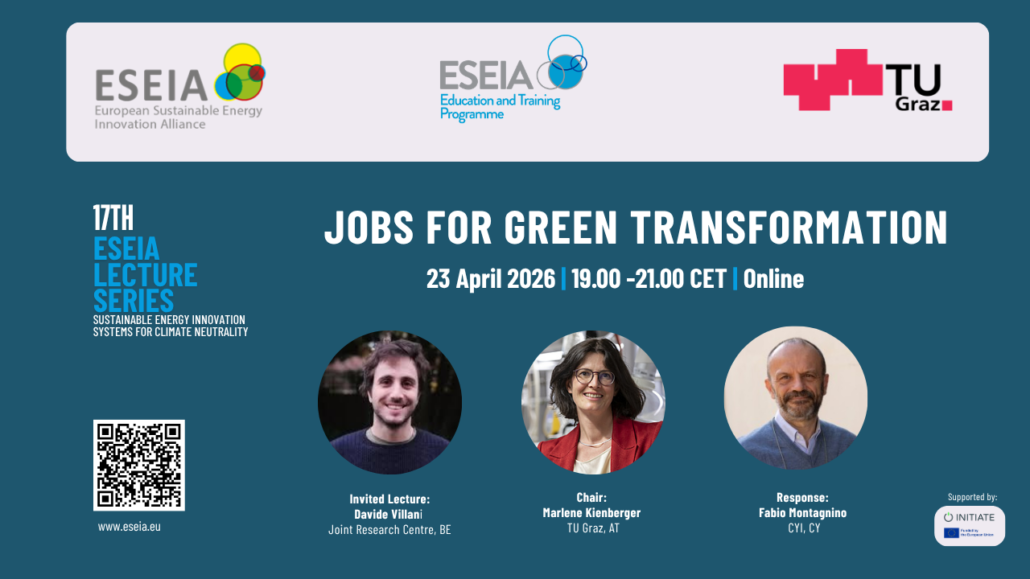
On 23 April 2026, the 17th ESEIA Lecture Series brought together 37 participants from 13 different countries, researchers, policymakers, educators, and innovation practitioners for a timely and wide-ranging discussion on one of the defining challenges of Europe’s green transition: building an inclusive, future-ready green workforce.
Co-organised by ESEIA, TU Graz, and the INITIATE Horizon Europe project, and held in online format, the session was hosted by ESEIA Director Brigitte Hasewend and chaired by Marlene Kienberger, TU Graz, AT.
Green Jobs at the Heart of the Green Industrial Deal
Europe’s green transition is not only a technological and regulatory transformation, it is a structural reshaping of labour markets. The Green Industrial Deal is accelerating demand for new green job profiles and new skills patterns across sectors, creating both opportunity and urgency for education systems, industries, and public institutions to respond.
It was in this context that Davide Villani, researcher at the European Commission’s Joint Research Centre (JRC) / Centre for Advanced Studies, delivered the invited lecture. Drawing on his research on labour relations, macroeconomics, and the social dimensions of the green and digital transitions, Villani explored how the shift toward green industries is generating strong demand for new competencies, and what this means for workers, higher education institutions, and policymakers across Europe.
His intervention raised fundamental questions about who benefits from the green transition, how skills gaps can be addressed systematically, and what role public policy must play in ensuring that green job creation is not only abundant but also equitable and geographically inclusive. Watch the Invited Lecture.
Response: Policy, Innovation, and the Ecosystem Perspective
Fabio Maria Montagnino, Head of Innovation and Entrepreneurship at The Cyprus Institute, offered a complementary perspective grounded in decades of experience promoting science-based start-ups and transnational innovation actions across European and Mediterranean regions. His response highlighted how functioning innovation ecosystems connecting researchers, entrepreneurs, industry, and public agencies, are essential for translating green policy ambitions into concrete employment opportunities on the ground. Watch the full response.
INITIATE Project
A distinctive feature of this edition was its connection to the INITIATE Horizon Europe project, one of the co-organisers of the event. INITIATE works with higher education institutions in Widening countries, including Croatia, North Macedonia, and Portugal, to support deep institutional transformation that strengthens R&I capacity and scientific excellence.
The lecture’s themes resonated directly with INITIATE’s mission: universities in Widening countries are at the front line of the green skills challenge, needing to adapt curricula, strengthen industry links, and build the innovation ecosystems that can turn green ambitions into real careers. The project’s co-design approach, developed with local stakeholders, SMEs, and public agencies offers a practical model for how this transformation can be achieved in diverse national contexts.
Subscribe to the ESEIA YouTube channel to stay up to date with future Lecture Series editions, conference sessions, and project updates from across the Alliance: @ESEIAAlliance
About the ESEIA Lecture Series
The ESEIA Lecture Series is a recurring format that brings together invited experts, institutional respondents, and ESEIA members for structured dialogue at the intersection of sustainable energy, research, innovation, education, and policy. Each edition is designed to generate substantive exchange between different actor perspectives, academic, institutional, and practitioner, on topics that matter for Europe’s clean energy transition.
For inquiries: office@eseia.eu

