

Key Takeaways from the 15th ESEIA Lecture: Building a Fair and Sustainable Future for Housing in Europe
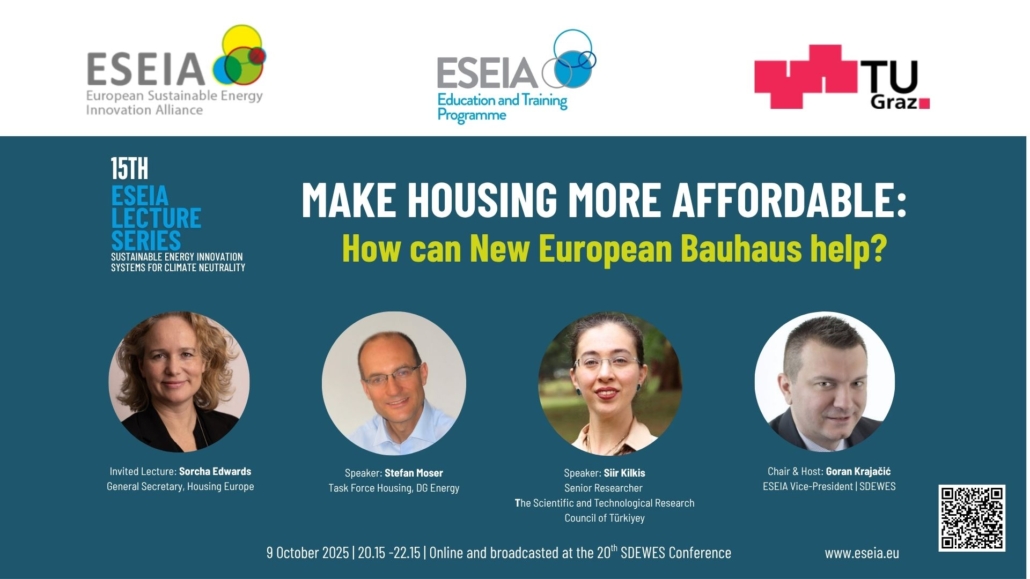
On 9 October 2025, the 15th edition of the ESEIA Lecture Series, titled “Making Housing More Affordable: How can New European Bauhaus help?”, brought together students, academia, experts, policymakers, and industry representatives to address one of today’s most pressing challenges: reconciling decarbonisation with housing affordability. Featuring an invited lecture by Sorcha Edwards, Secretary General of Housing Europe, the session was broadcast live from the 20th SDEWES Conference in Dubrovnik, Croatia, and explored innovative approaches to building sustainable, inclusive, and affordable living environments across Europe.
The lecture was chaired and hosted by Goran Krajačić, ESEIA Vice-President and SDEWES Conference Chair, and featured keynote speaker Sorcha Edwards, Secretary General of Housing Europe. Stefan Moser, Head of the Task Force on Housing at DG Energy, and Siir Kilkis, Senior Researcher and Science Adviser at the Scientific and Technological Research Council of Türkiye (TÜBİTAK), provided insightful responses, contributing to a dynamic discussion on sustainable and affordable housing solutions in Europe.
A Call to Reconcile Decarbonisation and Affordability
In her keynote lecture, Sorcha Edwards described the task of decarbonising homes and societies without worsening the housing affordability crisis as an “existential challenge.”
“We have to make sure that the decarbonisation processes don’t actually exacerbate or make the affordability crisis even worse. It’s this reconciliation that is extremely challenging,” she stressed.
Warning that speculation and reliance on market forces are “not leading us in the right direction,” Edwards called for inclusive and sustainable approaches that serve society as a whole. She argued that “the market cannot deliver both the housing and the decarbonisation challenge.”
Drawing on real-world examples, she highlighted innovative housing models that combine social and limited-profit systems, citing a Paris district renovated with geothermal heating and cooling as a sign of hope: “We can change this housing story in Europe,” she concluded, quoting the European Commissioner for Energy and Housing.
The Spirit of the New European Bauhaus
Edwards highlighted the transformative message of the New European Bauhaus (NEB): “together, sustainable, and beautiful.”
“It captured the imagination of our members, especially from Southern Europe, where aesthetics and tradition matter deeply. The NEB is about more than design, it’s about housing that serves society,” she said.
She emphasized that housing must be seen as a collective societal challenge, not an individual issue. “Housing has to be a societal challenge where we try to have housing that serves society. We have to base ourselves on projects that work and draw on creativity and innovation from across Europe,” she added.
Through the NEB, Edwards argued, Europe can build a movement grounded in tangible local success stories, supported by better governance, financing, and citizen empowerment.
Policy, Finance, and Local Innovation
The lecture also explored the EU’s evolving policy and financial frameworks for housing and the green transition. Edwards stressed that “the EU plays a vital role in setting ambition and guiding Member States through frameworks such as the Energy Performance of Buildings Directive and the Social Climate Fund.”
She highlighted that while some countries rely on EU instruments, others need long-term stability and stronger national mechanisms for housing renovation and energy efficiency.
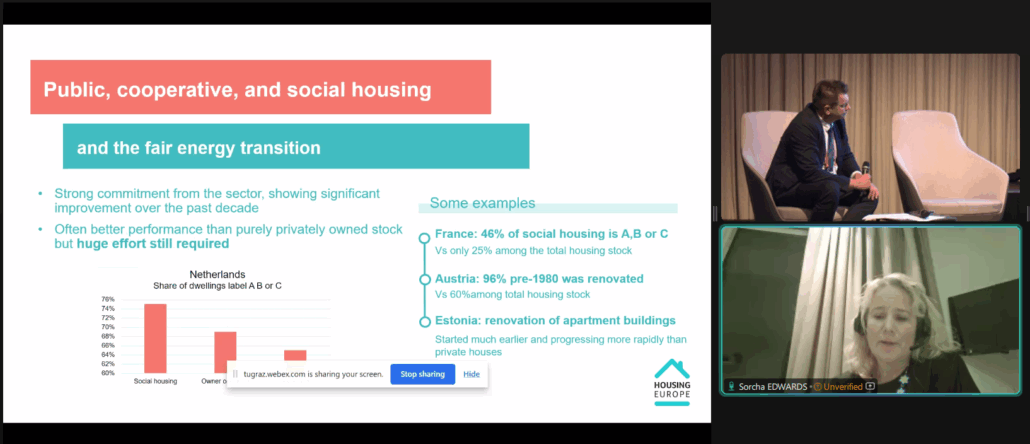
Showcasing success stories from Austria, the Netherlands, and Sweden, Edwards demonstrated that inclusive decarbonisation is achievable through good governance and collaboration: “It’s not just about technical issues—it’s about working with communities, gaining trust, and creating frameworks that make housing both affordable and sustainable.”
Responses from the Panel
Stefan Moser, DG Energy, reflected on the EU’s ongoing work to develop coherent policies that bridge energy efficiency and housing needs. He highlighted the importance of national renovation plans and the Task Force Housing’s efforts to support Member States in implementing the 2040 decarbonisation targets.
Siir Kilkis, The Scientific and Technological Research Council of Türkiye, offered a scientific perspective, emphasising the need for integrated urban systems that link energy, housing, and mobility. She referred to her research on mitigation potential and the role of cities in achieving climate neutrality.
Key Takeaways
- Reconciliation between decarbonisation and affordability is crucial for Europe’s sustainable future.
- The New European Bauhaus provides an inspiring framework rooted in community, inclusivity, and beauty.
- EU leadership must go hand in hand with strong local action and cooperation across public, cooperative, and social housing sectors.
- Successful pilot projects across Europe demonstrate that decarbonisation and social fairness can go together.
Looking Ahead
ESEIA will continue to promote dialogue on sustainable housing and urban innovation through its Lecture Series and collaborative EU projects. As the European Green Deal advances, these discussions will remain vital in ensuring that the energy transition truly “leaves no one behind.”
Watch the full lecture:
For further information:
Contact the ESEIA Team at office@eseia.eu

