
From Industrial Clusters to Circular Hubs: Why IS2H4C Could Be a Game Changer for Europe’s Circular Future
Interview with Devrim Murat Yazan, Project Coordinator and Associate Professor at the University of Twente’s IEBIS Department, NL
Across Europe, industrial clusters are under growing pressure to decarbonize, reduce waste, and rethink resource flows. While EU strategies support this transition, systemic implementation of Industrial Symbiosis (IS) remains uneven. Funded by Horizon Europe and coordinated by ESEIA member University of Twente, the IS2H4C project is creating a replicable model to help industries turn local challenges into circular opportunities.
We spoke with Devrim Murat Yazan, Project Coordinator and Associate Professor at the University of Twente’s IEBIS Department, to uncover the motivation behind IS2H4C, the transformative mechanisms driving the project, and how its framework can be scaled across Europe. ESEIA Director, Brigitte Hasewend, serves on the IS2H4C Advisory Board, reinforcing the alliance’s commitment to advancing circular innovation across industrial clusters in Europe.
ESEIA: What are the underlying drivers pushing Europe’s industrial regions to embrace large-scale Industrial Symbiosis, and why has it been so difficult to implement effectively until now?
Devrim Murat Yazan: Industrial Symbiosis (IS) is gaining momentum in Europe at a time when industrial regions are under immense pressure to decarbonize, become more resource-efficient, and reduce dependency on imported raw materials. The urgency is driven by environmental constraints, geopolitical needs, and the accelerating impacts of climate change. However, implementing IS effectively has been difficult due to systemic fragmentation. Industries tend to operate in silos, lacking mechanisms for cross-sector collaboration, standardized data, and shared infrastructure. IS2H4C responds to this challenge by bringing structure, digital intelligence, and multi-actor governance into the equation. The project aims to turn isolated experiments into a replicable and scalable model for regional industrial transformation, being an exemplary model for sustainable regional development.
ESEIA: What Makes IS2H4C Different? What is the vision behind IS2H4C, and how does the project shift the paradigm compared to past circular economy efforts?
Devrim Murat Yazan: IS2H4C represents a fundamental shift from previous circular economy efforts by focusing not just on individual technologies or bilateral exchanges, but on the creation of integrated, multi-sectoral Hubs for Circularity (H4Cs) building industrial/urban/rural symbiosis concept. These hubs serve as coordinated ecosystems that combine industrial production, infrastructure and urban/rural settings in the surrounding ecosystems of industrial zones, via local governance and digital innovation. What makes the project truly different is its systemic design methodology, supported by a digital platform that integrates physical resource flows with economic, environmental, and social data. Instead of treating circularity as an add-on, IS2H4C embeds it into the core structure of regional industrial systems, making circular economy implementation both scalable and locally grounded.
ESEIA: Can you share specific innovations or technologies being deployed across the four demonstration hubs? How are these advancing both environmental and economic performance?
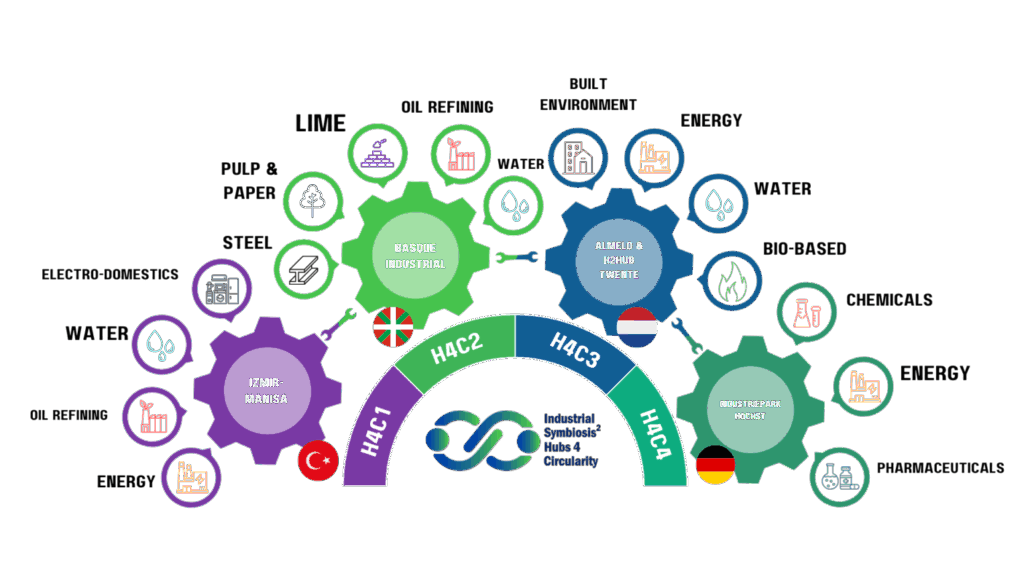
Devrim Murat Yazan: IS2H4C is deeply rooted in technological innovation. We scale up multiple circularity technologies from Technology Readiness Level TRL3-6 to TRL7-9. Across the four demonstration hubs in the Netherlands, Spain, Turkey, and Norway, advanced technologies are deployed to close loops and reduce environmental impact. Carbon capture and utilization (CCU) technologies are being used to recover industrial CO₂ and convert it into e-fuels such as e-methanol and e-methane, helping to replace fossil-based inputs. Green hydrogen, produced via electrolysis powered by renewable energy, is being tested as a clean energy carrier and as an enabler of synthetic fuel production. Wastewater treatment technologies are being optimized to enable water reuse and nutrient recovery, supporting local bio-based industry and reducing environmental discharge. Additionally, digital technologies play a central role. The IS2H4C platform includes decision support tools such as recommender systems that help identify viable symbiotic exchanges based on material compatibility, geographical proximity, and economic feasibility. These systems are complemented by simulation tools, decision-support dashboards, and circularity performance indicators that provide real-time insights to industrial stakeholders and policymakers. Together, these technologies make circularity actionable, traceable, and economically attractive.
ESEIA: Industrial transformation often overlooks social dynamics. How does IS2H4C engage with local communities, and what role do they play in shaping circular hubs?
Devrim Murat Yazan: One of the core strengths of IS2H4C is its commitment to local engagement. Industrial transformation cannot succeed without the involvement of communities, SMEs, and public stakeholders. Each hub in the project is embedded in a regional ecosystem where local governments, academic institutions, civil society, and industry collaborate to co-create the hub identity and define regional priorities. Living labs, stakeholder roundtables, and participatory design methods ensure that the symbiotic solutions developed are socially inclusive and locally accepted. This approach ensures that hubs are not imposed from above, but rather built collaboratively bottom-up.
ESEIA: From Pilot to Practice: What Will It Take? Scaling Industrial Symbiosis is notoriously complex. In your view, what structural or systemic barriers exist, and how does IS2H4C aim to overcome them to make replication viable?
Devrim Murat Yazan: Scaling industrial symbiosis is a complex task that requires overcoming several structural barriers. These include the lack of standardized data-sharing protocols, insufficient legal frameworks to support cross-sector collaboration, and limited access to circular finance mechanisms. IS2H4C tackles these challenges through a combination of standardized hub design methodology, policy alignment, and financial innovation. The project is developing modular business models tailored to local conditions, as well as blended finance approaches that combine public and private investment to de-risk circular infrastructure. Furthermore, the digital platform enables transparency, matchmaking, and performance monitoring, which are essential for scaling. By aligning governance, technology, and finance, IS2H4C creates the conditions necessary for industrial symbiosis to move from isolated pilots to systemic practice.
ESEIA: How is IS2H4C contributing to broader EU strategies such as the Green Deal, the Circular Economy Action Plan, or Processes4Planet?
Devrim Murat Yazan: IS2H4C is fully aligned with the European Green Deal, the Circular Economy Action Plan, and the Processes4Planet Partnership. The project directly contributes to decarbonization goals by deploying technologies that capture and utilize carbon, produce clean hydrogen, and generate e-fuels from industrial emissions. These efforts not only reduce greenhouse gas emissions but also support the transition to strategic autonomy in energy and materials. IS2H4C also contributes to the circularity and digitalization targets of the Green Deal by integrating industrial data into decision-support systems, thereby enabling smarter and more sustainable production. The hubs serve as testbeds for industrial resilience, demonstrating how circularity can be embedded in regional economies to create jobs, improve environmental performance, and build stronger supply chains.
ESEIA: What have been the most valuable insights from working across sectors and borders, and how are these shaping the project’s progress?
Devrim Murat Yazan: Operating across nine countries and diverse industrial sectors in four hubs for circularity has shown that circularity is not a one-size-fits-all concept. It must be adapted to local industrial structures, cultural norms, and policy environments. One of the most valuable insights has been the importance of trust and transparency in enabling data sharing and cross-sector collaboration. Technologies such as recommender systems and digital twins are only effective when stakeholders are willing to share operational data and co-invest in shared outcomes. The project has also demonstrated that dialogue between sectors—such as between chemicals, construction, and energy—can reveal unexpected synergies that would otherwise go unnoticed. These lessons are shaping the project’s replication strategy, which emphasizes context-specific solutions grounded in shared methodologies.
ESEIA: Who Can Follow Your Lead? What’s your message to other researchers, industries, or policymakers eager to embrace Industrial Symbiosis? How can they tap into the knowledge and tools being developed by IS2H4C?
Devrim Murat Yazan: IS2H4C offers a roadmap for researchers, industries, and policymakers who are eager to operationalize industrial symbiosis in their own regions. The project’s methodologies, and digital platform are being designed to be scalable and adaptable. For researchers, IS2H4C provides a rich ecosystem of models and case studies. For industries, it offers a pathway to reduce costs, enhance sustainability, and increase competitiveness. For policymakers, the project delivers evidence-based insights on how to design regulatory and financial frameworks that enable circular innovation. Our message is clear: industrial symbiosis is no longer experimental—it is necessary. With the right mix of collaboration, technology, and governance, circularity can become the new norm for European industry.
About IS2H4C:
IS2H4C project focuses on deploying systemic industrial symbiosis through innovative technologies like carbon capture and electrolysis. The initiative is driven by the vision of resource efficiency, renewable energy production, waste prevention, and fostering industrial-urban-rural symbiosis. The project aims to develop the most innovative sustainable technologies and infrastructure integration in four demo hubs and is supported by ground-breaking research on societal, governmental, and business innovation for H4C. IS2H4C scales up industrial areas to H4C via implementing systemic change and integrating the surrounding ecosystems to industrial areas.https://is2h4c-project.eu/
About Sustainable Energy Insight:
The ESEIA Blog – Sustainable Energy Insight aims to create a vibrant platform that informs, engages, and inspires sustainable energy experts. The blog will serve as a knowledge hub for ESEIA members, partners, and stakeholders, providing regular updates on projects, achievements, and opportunities in the renewable energy sector.
Interested in contributing? Share your insights through interviews, expert opinions, or project highlights. For more details or to contribute, contact us at office@eseia.eu.

